Malacostraca |
Decapoda |
Upogebiidae
Ambiente: milieu / zona climática / intervalo de profundidade / gama de distribuição
Ecologia
Bentopelágico; estuarina; pH range: 9.0 - 36.0; intervalo de profundidade 1 - 45 m (Ref. 128511). Subtropical; 48°N - 20°N, 19°W - 42°E
Eastern Atlantic, Mediterranean, Black Sea and Red Sea.
Comprimento na primeira maturidade / Tamanho / Peso / Idade
Maturidade: Lm ? range ? - ? cm Max length : 8.0 cm BL macho/indeterminado; (Ref. 128511); common length : 6.5 cm TL macho/indeterminado; (Ref. 4)
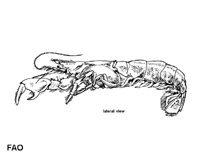
Rostrum ending in 3 teeth, the median long with a rounded apex ending in two spines; lateral teeth short, much shorter than half the median tooth, and separated from it by a deep groove. The median groove of the median tooth shallow. No spines on ventral surface of the rostrum. Anterolateral margin of the carapace with a small but distinct tooth at the level of the eye. First pereiopods subchelate. In the adult male the palm is distinctly widened at the base of the fixed finger, so that the height of the chela is only slightly less than the length. Movable finger with blunt tubercles on the cutting edge, but otherwise without tubercles, spines or ridges. Palm with 2 dorsal rows of spinules. Merus with a subdistal anterodorsal spine (Ref. 4).
It has a total body length of 4 to 6.5 cm (Ref. 4). It is found in intertidal and subtidal zones down to about 45 m, sometimes in estuarine areas. It makes simple Y-shaped burrows with 2 or more entrances in the mud or sandy mud (Ref. 4).
Ciclo de vida e comportamento de acasalamento
Maturidade | Reprodução | Desova | Ovos | Fecundidade | Larvas
Members of the order Decapoda are mostly gonochoric. Mating behavior: Precopulatory courtship ritual is common (through olfactory and tactile cues); usually indirect sperm transfer.
Holthuis, L.B. 1991 FAO Species Catalogue. Vol. 13. Marine lobsters of the world. An annotated and illustrated catalogue of species of interest to fisheries known to date. FAO Fish. Synop. 125(13):292p. Rome: FAO. (Ref. 4)
Categoria na Lista Vermelha da IUCN
(Ref. 130435: Version 2025-2 (Global))
Categoria CITES (Ref. 108899)
Not Evaluated
Not Evaluated
Ameaça para o homem
Utilização humana
Pescarias: pescarias de subsistência; isco: usually
FAO - Publication: search | FishSource |
Ferramentas
Mais informação
Ecologia TróficaProdutos alimentares (presas)
Composição da dieta
Consumo alimentar
Predadores
Ciclo de vidaReproduçãoMaturidadeFecundidadeDesovaOvosDesenvolvimento dos ovosLarvas FisiologiaConsumo de oxigénio
Relacionado com o ser humanoSelos, moedas, diversos.
Fontes da internet
Estimativas baseadas em modelos
Vulnerabilidade da pesca
(Ref. 71543) |
Low vulnerability (21 of 100). |
Categoria de preço
(Ref. 80766): |
Unknown. |