Malacostraca |
Decapoda |
Upogebiidae
Milieu: milieu / Klimaatzone / Diepte / verspreidingsgebied
Ecologie
Benthopelagisch; brak water; pH range: 9.0 - 36.0; diepte 1 - 45 m (Ref. 128511). Subtropical; 48°N - 20°N, 19°W - 42°E
Eastern Atlantic, Mediterranean, Black Sea and Red Sea.
Lengte bij maturiteit / Grootte / Gewicht / Leeftijd
Maturiteit: Lm ? range ? - ? cm Max length : 8.0 cm BL mannelijk / geslacht onbekend; (Ref. 128511); common length : 6.5 cm TL mannelijk / geslacht onbekend; (Ref. 4)
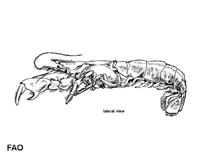
Rostrum ending in 3 teeth, the median long with a rounded apex ending in two spines; lateral teeth short, much shorter than half the median tooth, and separated from it by a deep groove. The median groove of the median tooth shallow. No spines on ventral surface of the rostrum. Anterolateral margin of the carapace with a small but distinct tooth at the level of the eye. First pereiopods subchelate. In the adult male the palm is distinctly widened at the base of the fixed finger, so that the height of the chela is only slightly less than the length. Movable finger with blunt tubercles on the cutting edge, but otherwise without tubercles, spines or ridges. Palm with 2 dorsal rows of spinules. Merus with a subdistal anterodorsal spine (Ref. 4).
It has a total body length of 4 to 6.5 cm (Ref. 4). It is found in intertidal and subtidal zones down to about 45 m, sometimes in estuarine areas. It makes simple Y-shaped burrows with 2 or more entrances in the mud or sandy mud (Ref. 4).
Levenscyclus en paargedrag
Maturiteit | Voortplanting | Paaien | Eieren | Fecunditeit | Larven
Members of the order Decapoda are mostly gonochoric. Mating behavior: Precopulatory courtship ritual is common (through olfactory and tactile cues); usually indirect sperm transfer.
Holthuis, L.B. 1991 FAO Species Catalogue. Vol. 13. Marine lobsters of the world. An annotated and illustrated catalogue of species of interest to fisheries known to date. FAO Fish. Synop. 125(13):292p. Rome: FAO. (Ref. 4)
Status op de Rode Lijst van het IUCN
(Ref. 130435: Version 2025-2 (Global))
CITES status (Ref. 108899)
Not Evaluated
Not Evaluated
Gevaar voor de mens
Gebruik door de mens
Visserij: visserij voor eigen gebruik; aas: usually
FAO - Publication: search | FishSource |
Tools
Meer informatie
Trofische ecologieVoedsel (prooien)
Dieetsamenstelling
Voedselconsumptie
Predatoren
LevenscyclusVoortplantingMaturiteitFecunditeitPaaienEierenOntwikkeling van de eierenLarven FysiologieZuurstofverbruik
Menselijk gerelateerdPostzegels, munten, diversen.
Internetbronnen
Schattingen op basis van modellen
Kwetsbaarheid van de visserij
(Ref. 71543) |
Low vulnerability (21 of 100). |
Prijsklasse
(Ref. 80766): |
Unknown. |