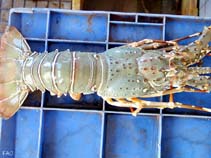
Malacostraca |
Decapoda |
Palinuridae
Milieu: milieu / Klimaatzone / Diepte / verspreidingsgebied
Ecologie
Benthic; brak water; diepte 3 - 90 m (Ref. 4). Tropical; 26°N - 14°S, 64°E - 145°E (Ref. 107402)
Indo-West Pacific: from the coasts of Pakistan and India to Vietnam, the Philippines, Indonesia, Northwest Australia and the Gulf of Papua.
Lengte bij maturiteit / Grootte / Gewicht / Leeftijd
Maturiteit: Lm 10.5 range ? - ? cm Max length : 40.0 cm TL mannelijk / geslacht onbekend; (Ref. 4); common length : 25.0 cm TL mannelijk / geslacht onbekend; (Ref. 4)
It has lengths of 40 cm, maximum total body length; 20 to 25 cm, common length. Occurs at a depth range from 3 to 90 m, but usually less than 40 m (Ref. 4). Subtidal (Ref. 106854). It is found on muddy substrates and sometimes on rocky bottoms near river mouths in turbid water (Ref. 4). Lives mainly at river-influenced shelf in shallow, turbid water with moderate run-off (Ref. 105109). In general, palinurids are mainly considered carnivores, usually feeding upon sluggish, easily captured animals where most material is eaten alive or freshly killed (Ref. 105260). Individuals reared in captivity fed on a natural diet of gastropods, clams, crabs, squids and fish (Ref. 105110).
Levenscyclus en paargedrag
Maturiteit | Voortplanting | Paaien | Eieren | Fecunditeit | Larven
Mating behavior: Precopulatory courtship ritual is common (through olfactory and tactile cues); usually indirect sperm transfer (Ref. 833).
Holthuis, L.B. 1991 FAO Species Catalogue. Vol. 13. Marine lobsters of the world. An annotated and illustrated catalogue of species of interest to fisheries known to date. FAO Fish. Synop. 125(13):292p. Rome: FAO. (Ref. 4)
Status op de Rode Lijst van het IUCN
(Ref. 130435: Version 2025-2 (Global))
CITES status (Ref. 108899)
Not Evaluated
Not Evaluated
Gevaar voor de mens
Gebruik door de mens
Visserij: commercieel
FAO - Aquaculture Systems: production search; Publication: search | FishSource | Sea Around Us
Tools
Meer informatie
FysiologieZuurstofverbruik
Menselijk gerelateerdPostzegels, munten, diversen.
Internetbronnen
Schattingen op basis van modellen
Weerstandsvermogen
(Ref. 69278): |
Hoog, minimale populatieverdubbelingstijd minder dan 15 maanden (K=1.58-1.83; tm=2.2) |
Kwetsbaarheid van de visserij
(Ref. 71543) |
Low vulnerability (23 of 100). |
Prijsklasse
(Ref. 80766): |
Very high. |
Nutrients
|
Calcium = 109 [35, 184] mg/100g; Iron = 1.59 [1.21, 1.97] mg/100g; Protein = 20.2 [19.2, 21.3] %; Omega3 = 0.285 [0.185, 0.386] g/100g; Selenium = 48.3 [-31.7, 128.3] μg/100g; VitaminA = 0 μg/100g; Zinc = 1.79 [1.17, 2.40] mg/100g (wet weight); based on nutrient studies. |