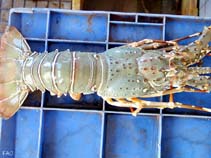
Malacostraca |
Decapoda |
Palinuridae
Lingkungan: lingkungan / zona iklim / kisaran kedalaman / jangkauan distribusi
Ekologi
Benthic; payau; kisaran kedalaman 3 - 90 m (Acuan 4). Tropical; 26°N - 14°S, 64°E - 145°E (Acuan 107402)
Indo-West Pacific: from the coasts of Pakistan and India to Vietnam, the Philippines, Indonesia, Northwest Australia and the Gulf of Papua.
Panjang pada saat jatuh tempo pertama / Ukuran / Berat / umur
Kematangan: Lm 10.5 range ? - ? cm Max length : 40.0 cm TL jantan/; (Acuan 4); common length : 25.0 cm TL jantan/; (Acuan 4)
It has lengths of 40 cm, maximum total body length; 20 to 25 cm, common length. Occurs at a depth range from 3 to 90 m, but usually less than 40 m (Ref. 4). Subtidal (Ref. 106854). It is found on muddy substrates and sometimes on rocky bottoms near river mouths in turbid water (Ref. 4). Lives mainly at river-influenced shelf in shallow, turbid water with moderate run-off (Ref. 105109). In general, palinurids are mainly considered carnivores, usually feeding upon sluggish, easily captured animals where most material is eaten alive or freshly killed (Ref. 105260). Individuals reared in captivity fed on a natural diet of gastropods, clams, crabs, squids and fish (Ref. 105110).
Mating behavior: Precopulatory courtship ritual is common (through olfactory and tactile cues); usually indirect sperm transfer (Ref. 833).
rujukan utama
Acuan | Koordinator | mitra
Holthuis, L.B. 1991 FAO Species Catalogue. Vol. 13. Marine lobsters of the world. An annotated and illustrated catalogue of species of interest to fisheries known to date. FAO Fish. Synop. 125(13):292p. Rome: FAO. (Acuan 4)
Status IUCN Red List
(Acuan 130435: Version 2025-2 (Global))
status CITES (Acuan 108899)
Not Evaluated
Not Evaluated
ancaman kepada manusia
penggunaan manusia
Perikanan: komersial
FAO - Aquaculture Systems: production search; Publication: search | FishSource | Laut di Sekitar Kita
Alat, peralatan
informasi lanjut
FisiologiKonsumsi oksigen
Yang berhubungan dengan manusiaPerangko, koin, dll.
Sumber internet
Estimasi berdasarkan model
Daya lenting
(Ref. 69278): |
Tinggi, Waktu penggandaan populasi minimum kurang dari 15 bulan (K=1.58-1.83; tm=2.2) |
Kerentanan Penangkapan Ikan
(Acuan 71543) |
Low vulnerability (23 of 100). |
kategori harga
(Acuan 80766): |
Very high. |
Nutrients
|
Calcium = 109 [35, 184] mg/100g; Iron = 1.59 [1.21, 1.97] mg/100g; Protein = 20.2 [19.2, 21.3] %; Omega3 = 0.285 [0.185, 0.386] g/100g; Selenium = 48.3 [-31.7, 128.3] μg/100g; VitaminA = 0 μg/100g; Zinc = 1.79 [1.17, 2.40] mg/100g (wet weight); based on nutrient studies. |