Malacostraca |
Decapoda |
Palinuridae
Environnement : milieu / zone climatique / profondeur / gamme de distribution
Écologie
Benthic; profondeur 0 - 120 m, usually 0 - 90 m. Subtropical, preferred 22°C (Réf. 107945); 22°S - 34°S, 113°E - 116°E (Réf. 4)
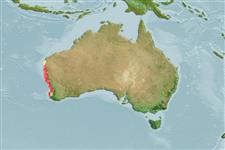
Indo-West Pacific: restricted to Western Australia.
Longueur à la première maturité / Taille / Poids / Âge
Maturité: Lm 7.0 range ? - ? cm Max length : 40.0 cm TL mâle / non sexé; (Réf. 4)
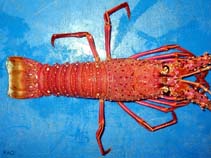
It has lengths of 40 cm, total body length; 14 cm, minimum carapace length; 8 and 10 cm, average carapace length; 9 to 11 cm, carapace length of ovigerous females or those with spermatophores (Ref. 4). The Western Australian Rock Lobster Fishery of this species has been certified by the Marine Stewardship Council (http://www.msc.org/) as well-managed and sustainable (http://www.msc.org/html/content_1277.htm). Occurs at depths between 0 and 90 m, rarely as deep as 120 m. The species are nocturnal and shelter in the daytime in rock crevices and among coral. They are omnivorous. They undertake limited migrations (Ref. 4). Juveniles spend 5 to 6 years in shallow-water reef areas, then moves offshore. They return from nocturnal foraging to the same den or one nearby, implying knowledge of topography (Ref. 106918). Phyllosomata of this species is observed to hitch and feed on its host salp Thetys vagina (Ref. 108806). Feeds on the coralline alga Corallina cuvieri (Ref. 122156).
Cycle de vie et comportement reproducteur
Maturité | Reproduction | Frai | Œufs | Fécondité | Larves
Brood and pelagic period lasts for 1.5 (Ref. 81134) and 10 months (Ref. 81163), respectively.
Holthuis, L.B. 1991 FAO Species Catalogue. Vol. 13. Marine lobsters of the world. An annotated and illustrated catalogue of species of interest to fisheries known to date. FAO Fish. Synop. 125(13):292p. Rome: FAO. (Réf. 4)
Statut dans la liste rouge de l'IUCN
(Réf. 130435: Version 2025-2 (Global))
statut CITES (Réf. 108899)
Not Evaluated
Not Evaluated
Menace pour l'homme
Utilisations par l'homme
Pêcheries: commercial
FAO - pêcheries: landings search; Publication: search | FishSource | Sea Around Us
Outils
Plus d'informations
Dynamique des populations PhysiologieConsommation d'oxygène
Liées à l'hommeTimbres, pièces de monnaie, divers
Sources Internet
Estimations basées sur des modèles
Résilience
(Ref. 69278): |
Faible, temps minimum de doublement de population : 4,5 à 14 années (K=0.09; tm=5) |
Rate of population increase
|
Prior r = 1.15, 95% CL = 0.76 - 1.73, Based on 3 data-limited stock assessments. |
Vulnérabilité de la pêche
(Réf. 71543) |
High vulnerability (55 of 100). |
Vulnérabilité climatique
(Réf. 125649) |
High to very high vulnerability (67 of 100) |
Catégorie de prix
(Réf. 80766): |
Very high. |
Nutrients
|
Calcium = 109 [35, 184] mg/100g; Iron = 1.59 [1.21, 1.97] mg/100g; Protein = 20.2 [19.2, 21.3] %; Omega3 = 0.285 [0.185, 0.386] g/100g; Selenium = 48.3 [-31.7, 128.3] μg/100g; VitaminA = 0 μg/100g; Zinc = 1.79 [1.17, 2.40] mg/100g (wet weight); based on nutrient studies. |