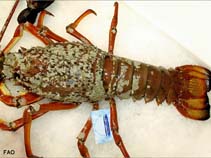
Malacostraca |
Decapoda |
Palinuridae
Milieu: milieu / Klimaatzone / Diepte / verspreidingsgebied
Ecologie
Benthic; diepte 0 - 155 m (Ref. 4). Subtropical, preferred 14°C (Ref. 107945); 26°S - 47°S, 146°E - 173°W (Ref. 4)
Indo-West Pacific.
Lengte bij maturiteit / Grootte / Gewicht / Leeftijd
Maturiteit: Lm 15.5, range 14 - ? cm Max length : 61.0 cm TL mannelijk / geslacht onbekend; (Ref. 89420); common length : 30.5 cm TL mannelijk / geslacht onbekend; (Ref. 89420)
Carapace length: 25 cm; total body length: 38 to 56 cm and carapace lengths: 16 to 24 cm (ovigerous females) (Ref. 4). Inhabits substrates of sand, gravel or rocks. Smaller specimens seem to be more frequent on rocky bottoms (Ref. 4). Phyllosomas are opportunistic predators. Early stage phyllosomas are suited to ingest soft prey such as polychaete worms, medusae and ctenophores, while later stages may consume fish larvae and mussel flesh. In general, lobsters are opportunistic feeders, consuming a variety of sessile invertebrates (Ref. 105202).
Levenscyclus en paargedrag
Maturiteit | Voortplanting | Paaien | Eieren | Fecunditeit | Larven
Females are ovigerous from late September to January (Ref. 4).
Holthuis, L.B. 1991 FAO Species Catalogue. Vol. 13. Marine lobsters of the world. An annotated and illustrated catalogue of species of interest to fisheries known to date. FAO Fish. Synop. 125(13):292p. Rome: FAO. (Ref. 4)
Status op de Rode Lijst van het IUCN
(Ref. 130435: Version 2025-2 (Global))
CITES status (Ref. 108899)
Not Evaluated
Not Evaluated
Gevaar voor de mens
Gebruik door de mens
Visserij: commercieel
FAO - visserij: landings search; Publication: search | FishSource | Sea Around Us
Tools
Meer informatie
Trofische ecologieVoedsel (prooien)
Dieetsamenstelling
Voedselconsumptie
Predatoren
PopulatiedynamicaGroei
Max. leeftijden / maten
Lengte-gewicht rel.
Lengte-lengte rel.
Lengtefrequenties
Massaconversie
Abundantie
FysiologieZuurstofverbruik
Menselijk gerelateerdPostzegels, munten, diversen.
Internetbronnen
Schattingen op basis van modellen
Kwetsbaarheid van de visserij
(Ref. 71543) |
Moderate vulnerability (44 of 100). |
Kwetsbaarheid voor het klimaat
(Ref. 125649) |
Moderate to high vulnerability (49 of 100) |
Prijsklasse
(Ref. 80766): |
Very high. |
Nutrients
|
Calcium = 109 [35, 184] mg/100g; Iron = 1.59 [1.21, 1.97] mg/100g; Protein = 20.2 [19.2, 21.3] %; Omega3 = 0.285 [0.185, 0.386] g/100g; Selenium = 48.3 [-31.7, 128.3] μg/100g; VitaminA = 0 μg/100g; Zinc = 1.79 [1.17, 2.40] mg/100g (wet weight); based on nutrient studies. |