Malacostraca |
Decapoda |
Palinuridae
Ambiente: milieu / zona climatica / distribuzione batimetrica / gamma di distribuzione
Ecologia
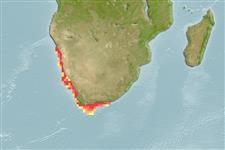
Benthic; distribuzione batimetrica 0 - 200 m (Fonte Biblio. 4). Subtropical, preferred 18°C (Fonte Biblio. 107945); 21°S - 37°S, 12°E - 26°E (Fonte Biblio. 4)
Southeast Atlantic: Namibia to South Africa.
Lunghezza alla prima maturità / Dimensione / Peso / Età
Maturità: Lm 6.6, range 5 - ? cm Max length : 46.0 cm BL maschio/sesso non determinato; (Fonte Biblio. 4)
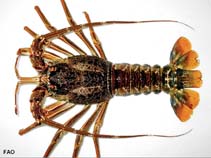
It has a maximum total body length of 46 cm and a carapace length of 18 cm. Maximum depth from Ref. 432'>113432. Fisheries: The tails of this species are exported frozen in the shell, or peeled and canned. Experimental work on culture techniques for this species are underway in South Africa. Protective measures includes a size limit (carapace length 8.5 cm), a closed season from July 1 to October 31, bag limits for sports fishermen (2 specimens per day), and the prohibition of taking ovigerous females or soft shelled specimens (Ref. 4). Occurs at depths from 0 to 46 m of coastal waters and inhabits rocky bottoms, sometimes with patches of sand and mud (Ref. 4).
Ciclo vitale e comportamento di accoppiamento
Maturità | Riproduzione | Deposizione | Uova | Fecondità | Larve
The males molt between September and December. In the females, molting occurs in April or May, after which copulation takes place. Ovigerous females are found from May to October (Ref. 4).
Holthuis, L.B. 1991 FAO Species Catalogue. Vol. 13. Marine lobsters of the world. An annotated and illustrated catalogue of species of interest to fisheries known to date. FAO Fish. Synop. 125(13):292p. Rome: FAO. (Fonte Biblio. 4)
Stato della Lista Rossa IUCN
(Fonte Biblio. 130435: Version 2025-2 (Global))
Stato della CITES (Fonte Biblio. 108899)
Not Evaluated
CMS (Fonte Biblio. 116361)
Not Evaluated
Minaccia per l'uomo
Usi umani
Pesca: commerciale
FAO - pesca: landings search; Publication: search | FishSource | Sea Around Us
Strumenti
Informazioni ulteriori
Dinamica della popolazione FisiologiaConsumo di ossigeno
Legato all'uomoFrancobolli, monete, materiale vario.
Fonti Internet
Stime basate su modelli
Resilienza
(Ref. 69278): |
Basso, tempo minimo di raddoppiamento della popolazione 4.5 - 14 anni (K=0.1-0.11) |
Vulnerabilità della pesca
(Fonte Biblio. 71543) |
High vulnerability (56 of 100). |
Vulnerabilità climatica
(Fonte Biblio. 125649) |
Very high vulnerability (85 of 100) |
Categoria di prezzo
(Fonte Biblio. 80766): |
Very high. |
Nutrients
|
Calcium = 109 [35, 184] mg/100g; Iron = 1.59 [1.21, 1.97] mg/100g; Protein = 20.2 [19.2, 21.3] %; Omega3 = 0.285 [0.185, 0.386] g/100g; Selenium = 48.3 [-31.7, 128.3] μg/100g; VitaminA = 0 μg/100g; Zinc = 1.79 [1.17, 2.40] mg/100g (wet weight); based on nutrient studies. |