Asteroidea |
Valvatida |
Asterinidae
Environnement : milieu / zone climatique / profondeur / gamme de distribution
Écologie
Benthic; profondeur 0 - 10 m (Réf. 107862). Subtropical
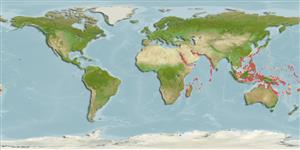
Indo-Pacific and the Mediterranean.
Longueur à la première maturité / Taille / Poids / Âge
Maturité: Lm ? range ? - ? cm
Common in the lower eulittoral zone under rock slabs and boulders (Ref. 102838). Members of the family Asterinidae are very opportunistic feeders, feeding indiscriminately on small epifaunal organisms, detritus, decaying animals and plants, and live algae (Ref. 108108). Deposit feeder (Ref. 90951). Found in waters less than 30m. Associated with coral communities. Hides under rocks during the day. Feeds on bacterial film (Ref. 129602).
Cycle de vie et comportement reproducteur
Maturité | Reproduction | Frai | Œufs | Fécondité | Larves
Members of the class Asteroidea exhibit both asexual (regeneration and clonal) and sexual (gonochoric) means of reproduction. Life cycle: Embryos hatch into planktonic larvae and later metamorphose into pentamorous juveniles which develop into young sea stars with stubby arms.
Koukouras, A. and M.-S. Kitsos 2010 Echinoderms. pp.288-296 In Coll, M., et al., 2010. The biodiversity of the Mediterranean Sea: estimates, patterns, and threats. PLoS ONE 5(8):36pp. (Réf. 85345)
Statut dans la liste rouge de l'IUCN
(Réf. 130435: Version 2025-2 (Global))
statut CITES (Réf. 108899)
Not Evaluated
Not Evaluated
Menace pour l'homme
Harmless
Utilisations par l'homme
FAO - Publication: search | FishSource |
Outils
Plus d'informations
Dynamique des populationsCroissance
Âges / tailles maximales
Longueur-poids rel.
Rel. longueur-longueur.
Fréquences de longueurs
Conversion de masse
Abondance
Cycle de vieReproductionMaturitéFéconditéFraiŒufsDéveloppement de l'œufLarves PhysiologieConsommation d'oxygène
Liées à l'hommeTimbres, pièces de monnaie, divers
Sources Internet
Estimations basées sur des modèles
Vulnérabilité de la pêche
(Réf. 71543) |
(0 of 100). |