Hexacorallia |
Actiniaria |
Actiniidae
Ambiente: milieu / zona climática / intervalo de profundidade / gama de distribuição
Ecologia
Associadas(os) a recifes; intervalo de profundidade 0 - 200 m (Ref. 102444). Tropical
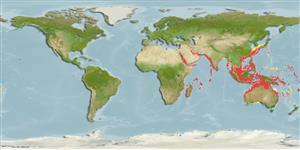
Indo-Pacific: Micronesia and Melanesia to east Africa and the Red Sea and from Australia to Japan.
Comprimento na primeira maturidade / Tamanho / Peso / Idade
Maturidade: Lm ? range ? - ? cm Max length : 40.0 cm WD macho/indeterminado; (Ref. 9810)
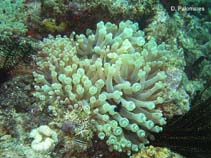
Tentacle up to 10 cm in length and are usually brown with bulb at or below the end. Tip of the tentacle is usually red with the equator of the bulb white. Bulb is said to be related to presence of fish and may be absent in which case tentacles have a white ring where the equator of the bulb would have formed. Shallow water specimens have small polyps with oral disc diameter about 5cm and are clustered together in crevices or adjacent to coral branches so that they appear confluent and forms an extensive field. In deep water they may reach up to 40cm diameter (oral disc) and are solitary.
Commonly attached deeply in crevice or hole so that only tentacles are visible (Ref. 9810). Attached specifically deep within a crevice on coral reefs and among rocks (Ref. 102838). Collumn without verrucae and usually brown, sometimes reddish or greenish. Oral disc same brown color with tentacles and these tentacles collapse when disturbed (Ref. 9810). Smaller individuals are clustered in shallow waters. Larger individuals are usually solitary, and found in deeper waters. Has a symbiotic zooxanthellae, which produces food through photosynthesis (Ref. 125532). Host to the clown fish Amphiprion clarkii (Ref. 102838). Sea anemones in general feed on various invertebrates; some are suspension feeders (Ref. 833).
Ciclo de vida e comportamento de acasalamento
Maturidade | Reprodução | Desova | Ovos | Fecundidade | Larvas
Members of the class Anthozoa are either gonochoric or hermaphroditic. Mature gametes are shed into the coelenteron and spawned through the mouth. Life cycle: The zygote develops into a planktonic planula larva. Metamorphosis begins with early morphogenesis of tentacles, septa and pharynx before larval settlement on the aboral end.
Fautin, D.G. 2007 Hexacorallians of the World. http://geoportal.kgs.ku.edu/hexacoral/anemone2/index.cfm[accessed08/07/16] (Ref. 77115)
Categoria na Lista Vermelha da IUCN
(Ref. 130435: Version 2025-2 (Global))
Categoria CITES (Ref. 108899)
Not Evaluated
Not Evaluated
Ameaça para o homem
Harmless
Utilização humana
FAO - Publication: search | FishSource |
Ferramentas
Mais informação
Ecologia TróficaProdutos alimentares (presas)
Composição da dieta
Consumo alimentar
Predadores
Dinâmica das populaçõesCrescimento
Idades / tamanhos máximos
Comprimento-peso rel.
Comprimento-comprimento rel.
Frequência de comprimento
Conversão de massa
Abundância
Ciclo de vidaReproduçãoMaturidadeFecundidadeDesovaOvosDesenvolvimento dos ovosLarvas FisiologiaConsumo de oxigénio
Relacionado com o ser humanoSelos, moedas, diversos.
Fontes da internet
Estimativas baseadas em modelos
Vulnerabilidade da pesca
(Ref. 71543) |
Low to moderate vulnerability (30 of 100). |