Cephalopoda |
Octopoda |
Octopodidae
Environnement : milieu / zone climatique / profondeur / gamme de distribution
Écologie
Benthic; profondeur 0 - 20 m (Réf. 96968). Tropical
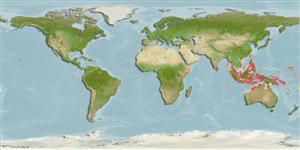
Indo-West Pacific: Indo-Malayan Archipelago.
Longueur à la première maturité / Taille / Poids / Âge
Maturité: Lm ? range ? - ? cm Max length : 23.0 cm TL mâle / non sexé; (Réf. 96968)
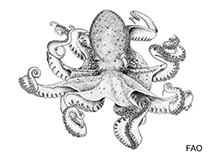
Mantle length is 3.6 cm. This species is frequently confused with the mimic octopus (Thaumoctopus mimicus) which co-occurs in similar tropical habitats. Some aquarium trade occurs for this species. Its high tourism, photography and documentary profile shows its significant commercial value alive especially in Bali and northern Sulawesi, Indonesia (Ref. 96968). This species has been encountered primarily on soft sediment substrates where it occupies burrows in deep sand. Individuals were found to occupy the same burrow for periods of at least three weeks. This species appears to have a crepuscular activity pattern, emerging to forage during half-light periods at dusk and dawn (Ref. 96968). Feeds on small crustaceans and fishes (Ref. 7937).
Cycle de vie et comportement reproducteur
Maturité | Reproduction | Frai | Œufs | Fécondité | Larves
Members of the class Cephalopoda are gonochoric. Male and female adults usually die shortly after spawning and brooding, respectively. Mating behavior: Males perform various displays to attract potential females for copulation. During copulation, male grasp the female and inserts the hectocotylus into the female's mantle cavity where fertilization usually occurs. Life cycle: Embryos hatch into planktonic stage and live for some time before they grow larger and take up a benthic existence as adults.
Hochberg, F.G., M.D. Norman and J. Finn 2006 Wunderpus photogenicus n. gen. and sp., a new octopus from the shallow waters of the Indo-Malayan Archipelago (Cephalopoda: Octopodidae). Molluscan Research 26(3):128-140. (Réf. 7937)
Statut dans la liste rouge de l'IUCN
(Réf. 130435: Version 2025-2 (Global))
statut CITES (Réf. 108899)
Not Evaluated
Not Evaluated
Menace pour l'homme
Harmless
Utilisations par l'homme
FAO - Publication: search | FishSource |
Outils
Plus d'informations
Écologie trophiqueAliments (proies)
Composition du régime alimentaire
Consommation alimentaire
Prédateurs
Dynamique des populationsCroissance
Âges / tailles maximales
Longueur-poids rel.
Rel. longueur-longueur.
Fréquences de longueurs
Conversion de masse
Abondance
Cycle de vieReproductionMaturitéFéconditéFraiŒufsDéveloppement de l'œufLarves PhysiologieConsommation d'oxygène
Liées à l'hommeTimbres, pièces de monnaie, divers
Sources Internet
Estimations basées sur des modèles
Vulnérabilité de la pêche
(Réf. 71543) |
Low vulnerability (13 of 100). |