Cephalopoda |
Octopoda |
Octopodidae
Milieu: milieu / Klimaatzone / Diepte / verspreidingsgebied
Ecologie
Benthic; diepte 0 - 20 m (Ref. 96968). Tropical
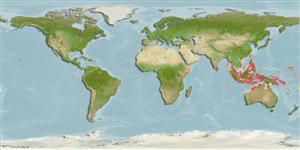
Indo-West Pacific: Indo-Malayan Archipelago.
Lengte bij maturiteit / Grootte / Gewicht / Leeftijd
Maturiteit: Lm ? range ? - ? cm Max length : 23.0 cm TL mannelijk / geslacht onbekend; (Ref. 96968)
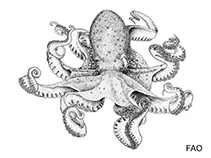
Mantle length is 3.6 cm. This species is frequently confused with the mimic octopus (Thaumoctopus mimicus) which co-occurs in similar tropical habitats. Some aquarium trade occurs for this species. Its high tourism, photography and documentary profile shows its significant commercial value alive especially in Bali and northern Sulawesi, Indonesia (Ref. 96968). This species has been encountered primarily on soft sediment substrates where it occupies burrows in deep sand. Individuals were found to occupy the same burrow for periods of at least three weeks. This species appears to have a crepuscular activity pattern, emerging to forage during half-light periods at dusk and dawn (Ref. 96968). Feeds on small crustaceans and fishes (Ref. 7937).
Levenscyclus en paargedrag
Maturiteit | Voortplanting | Paaien | Eieren | Fecunditeit | Larven
Members of the class Cephalopoda are gonochoric. Male and female adults usually die shortly after spawning and brooding, respectively. Mating behavior: Males perform various displays to attract potential females for copulation. During copulation, male grasp the female and inserts the hectocotylus into the female's mantle cavity where fertilization usually occurs. Life cycle: Embryos hatch into planktonic stage and live for some time before they grow larger and take up a benthic existence as adults.
Hochberg, F.G., M.D. Norman and J. Finn 2006 Wunderpus photogenicus n. gen. and sp., a new octopus from the shallow waters of the Indo-Malayan Archipelago (Cephalopoda: Octopodidae). Molluscan Research 26(3):128-140. (Ref. 7937)
Status op de Rode Lijst van het IUCN
(Ref. 130435: Version 2025-2 (Global))
CITES status (Ref. 108899)
Not Evaluated
Not Evaluated
Gevaar voor de mens
Harmless
Gebruik door de mens
FAO - Publication: search | FishSource |
Tools
Meer informatie
Trofische ecologieVoedsel (prooien)
Dieetsamenstelling
Voedselconsumptie
Predatoren
PopulatiedynamicaGroei
Max. leeftijden / maten
Lengte-gewicht rel.
Lengte-lengte rel.
Lengtefrequenties
Massaconversie
Abundantie
LevenscyclusVoortplantingMaturiteitFecunditeitPaaienEierenOntwikkeling van de eierenLarven FysiologieZuurstofverbruik
Menselijk gerelateerdPostzegels, munten, diversen.
Internetbronnen
Schattingen op basis van modellen
Kwetsbaarheid van de visserij
(Ref. 71543) |
Low vulnerability (13 of 100). |