Bivalvia |
Cardiida |
Cardiidae
Ambiente: milieu / zona climática / intervalo de profundidade / gama de distribuição
Ecologia
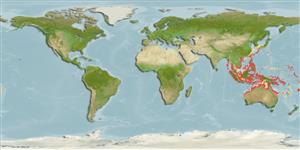
Benthic; intervalo de profundidade 0 - 35 m (Ref. 75831). Tropical; 23°C - 30°C (Ref. 102835); 38°N - 29°S, 92°E - 178°W
Indo-Pacific: from Myanmar then east to Wallis and Futuna, north to Japan and south to western Australia. Introduced beyond Wallis and Futuna in the Pacific.
Comprimento na primeira maturidade / Tamanho / Peso / Idade
Maturidade: Lm ?, range 25 - 35 cm Max length : 137 cm SHL macho/indeterminado; (Ref. 99323); common length : 80.0 cm SHL macho/indeterminado; (Ref. 348); peso máx. Publicado: 500.0 kg (Ref. 81839)
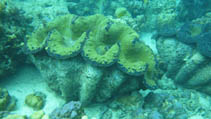
It is white and fan-shaped with deep radiating ribs.
Known to be the largest bivalve mollusks that exist. Exploited for its meat and shell, this species has recently become nearly extinct within an important part of its range, due to over collecting. Trials of aquaculture under progress for the restocking of reefs and local farming (Ref. 348). Facultative planktotroph. It has an established symbiotic relationship with a dinoflagellate algae (zooxanthellae) which allows them to survive. It ingests the algae at an early stage and the latter propagates in the gut (Ref. 100719).
Ciclo de vida e comportamento de acasalamento
Maturidade | Reprodução | Desova | Ovos | Fecundidade | Larvas
Becomes simultaneous hermaphrodite in its later years. Spawning is seasonal, based on its northern and southern limits of distribution (Ref. 100714).
SAUP Database 2006 SAUP Database. www.seaaroundus.org. (Ref. 356)
Categoria na Lista Vermelha da IUCN
(Ref. 130435: Version 2025-2 (Global))
Categoria CITES (Ref. 108899)
Not Evaluated
Ameaça para o homem
Utilização humana
Pescarias: espécies comerciais; Aquacultura: espécies comerciais
FAO - Aquaculture Systems: production search; Publication: search | FishSource | Sea Around Us
Ferramentas
Mais informação
FisiologiaConsumo de oxigénio
Relacionado com o ser humanoSelos, moedas, diversos.
Fontes da internet
Estimativas baseadas em modelos
Resiliência
(Ref. 69278): |
Baixo, tempo mínimo de duplicação da população 4,5 - 14 anos (K=0.07-0.2) |
Vulnerabilidade da pesca
(Ref. 71543) |
High to very high vulnerability (73 of 100). |
Categoria de preço
(Ref. 80766): |
Unknown. |
Nutrients
|
Calcium = 149 [71, 228] mg/100g; Iron = 8.53 [1.95, 15.11] mg/100g; Protein = 9.88 [8.64, 11.12] %; Omega3 = 0.313 [0.202, 0.423] g/100g; Selenium = 61 [50, 72] μg/100g; VitaminA = 0 μg/100g; Zinc = 2.04 [0.56, 3.51] mg/100g (wet weight); based on nutrient studies. |