Bivalvia |
Mytilida |
Mytilidae
環境: 環境 / 氣候帶 / 深度上下限 / 配送範圍
生態學
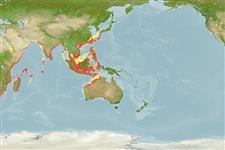
Benthic; 半鹹淡水; 深度上下限 0 - 100 m (參考文獻 356), usually 0 - 20 m. Tropical, preferred 25°C (參考文獻 107945); 46°N - 35°S, 20°E - 130°E (參考文獻 348)
Indo-Pacific and Western Central Atlantic.
初熟時的長度 / 大小 / 重量 / 年齡
成熟度: Lm ? range ? - ? cm Max length : 16.5 cm SHL 雄魚/尚未辨別雌雄; (參考文獻 348); common length : 8.0 cm SHL 雄魚/尚未辨別雌雄; (參考文獻 348)
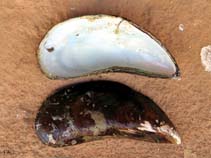
Shell elongate, roughly trigonal-ovate in outline, swollen and pointed anteriorly, rounded and compressed posteriorly. Umbones terminal and sharply tapering, rather incurved. Anterior margin reduced. Ventral margin long and often somewhat concave. Outer surface nearly smooth apart from concentric growth marks and faint radial lines. Periostracum rather thick and smooth, adherent. Ligamental ridge finely pitted. Hinge with 1 small tooth in right valve and 2 in the left. Anterior adductor scar absent in adult specimens. Posterior retractor scars large, confluent with the posterior adductor scar. Anterior retractor scar separated, elongate-ovate in shape, situated a short way to posterior end of ligament. Internal margins smooth. Colour: outside of shell whitish under a bright periostracum which is dark brownish green anteriorly and olive-green to bright green posteriorly. Interior an iredescent pale bluish green, with a vivid green margin on periostracum.
The figures from FAO comprise the production of Mytilus viridis from Malaysia and Singapore and also production reported under the name Mytilus smaragdinus from the Philippines and Thailand; they all refer to the same species (Ref. 348). Commonly found byssally attached to various hard objects or substrates in protected bays and estuaries (Ref. 80041). Littoral and sublittoral to a depth of 20 m (Ref. 348). Can thrive even in adverse environments due to its ability to tolerate elevated levels of pollutants and oxygen depletion (Ref. 125512).
生命週期和交配行為
成熟度 | 繁殖 | 產卵場 | 卵 | 孕卵數 | 仔魚
External sexual fertilization. Spawning peaks coincide with monsoon seasons except in the Philippines and Thailand where spawning is year-round (Ref. 80527). Both sexes release gametes in the water column, where developed larvae remain for two weeks before settling in benthic habitat as juveniles. Sexual maturity occurs at 15-30 mm shell length, roughly 2-3 months age.
主要參考資料
參考文獻 | 合作者 | 合作者
Poutiers, J.M. 1998 Bivalves. Acephala, Lamellibranchia, Pelecypoda. p. 123-362. In Carpenter, K. E. and V. H. Niem. 1998. FAO species identification guide for fishery purposes. The living marine resources of the Western Central Pacific. Volume 1. Seaweeds, corals, bivalves, and gastropods. Rome, FAO. (參考文獻 348)
IUCN 瀕危狀態
(參考文獻 130435: Version 2025-2 (Global))
CITES狀態 (參考文獻 108899)
Not Evaluated
Not Evaluated
對人類具威脅
人類使用
漁業: 高經濟性
FAO - Aquaculture Systems: production search漁業: 魚種描繪, landings search; Publication: search | FishSource | 周邊海洋
工具
網路資源
基於模型的估計
回復力
(Ref. 69278): |
高度, 族群倍增時間少於 15個月 (K=0.17-2.37) |
釣魚的脆弱性
(參考文獻 71543) |
Low vulnerability (10 of 100). |
氣候脆弱性
(參考文獻 125649) |
Moderate to high vulnerability (48 of 100) |
價格種類
(參考文獻 80766): |
Medium. |
Nutrients
|
Calcium = 149 [71, 228] mg/100g; Iron = 8.53 [1.95, 15.11] mg/100g; Protein = 9.88 [8.64, 11.12] %; Omega3 = 0.313 [0.202, 0.423] g/100g; Selenium = 61 [50, 72] μg/100g; VitaminA = 0 μg/100g; Zinc = 2.04 [0.56, 3.51] mg/100g (wet weight); based on nutrient studies. |