Malacostraca |
Decapoda |
Palinuridae
Ambiente: milieu / zona climática / intervalo de profundidade / gama de distribuição
Ecologia
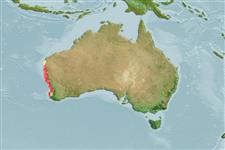
Benthic; intervalo de profundidade 0 - 120 m, usually 0 - 90 m. Subtropical, preferred 22°C (Ref. 107945); 22°S - 34°S, 113°E - 116°E (Ref. 4)
Indo-West Pacific: restricted to Western Australia.
Comprimento na primeira maturidade / Tamanho / Peso / Idade
Maturidade: Lm 7.0 range ? - ? cm Max length : 40.0 cm TL macho/indeterminado; (Ref. 4)
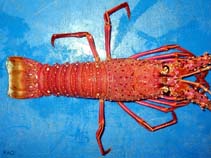
It has lengths of 40 cm, total body length; 14 cm, minimum carapace length; 8 and 10 cm, average carapace length; 9 to 11 cm, carapace length of ovigerous females or those with spermatophores (Ref. 4). The Western Australian Rock Lobster Fishery of this species has been certified by the Marine Stewardship Council (http://www.msc.org/) as well-managed and sustainable (http://www.msc.org/html/content_1277.htm). Occurs at depths between 0 and 90 m, rarely as deep as 120 m. The species are nocturnal and shelter in the daytime in rock crevices and among coral. They are omnivorous. They undertake limited migrations (Ref. 4). Juveniles spend 5 to 6 years in shallow-water reef areas, then moves offshore. They return from nocturnal foraging to the same den or one nearby, implying knowledge of topography (Ref. 106918). Phyllosomata of this species is observed to hitch and feed on its host salp Thetys vagina (Ref. 108806). Feeds on the coralline alga Corallina cuvieri (Ref. 122156).
Ciclo de vida e comportamento de acasalamento
Maturidade | Reprodução | Desova | Ovos | Fecundidade | Larvas
Brood and pelagic period lasts for 1.5 (Ref. 81134) and 10 months (Ref. 81163), respectively.
Holthuis, L.B. 1991 FAO Species Catalogue. Vol. 13. Marine lobsters of the world. An annotated and illustrated catalogue of species of interest to fisheries known to date. FAO Fish. Synop. 125(13):292p. Rome: FAO. (Ref. 4)
Categoria na Lista Vermelha da IUCN
(Ref. 130435: Version 2025-2 (Global))
Categoria CITES (Ref. 108899)
Not Evaluated
Not Evaluated
Ameaça para o homem
Utilização humana
Pescarias: espécies comerciais
FAO - pescarias: landings search; Publication: search | FishSource | Sea Around Us
Ferramentas
Mais informação
FisiologiaConsumo de oxigénio
Relacionado com o ser humanoSelos, moedas, diversos.
Fontes da internet
Estimativas baseadas em modelos
Resiliência
(Ref. 69278): |
Baixo, tempo mínimo de duplicação da população 4,5 - 14 anos (K=0.09; tm=5) |
Rate of population increase
|
Prior r = 1.15, 95% CL = 0.76 - 1.73, Based on 3 data-limited stock assessments. |
Vulnerabilidade da pesca
(Ref. 71543) |
High vulnerability (55 of 100). |
Vulnerabilidade climática
(Ref. 125649) |
High to very high vulnerability (67 of 100) |
Categoria de preço
(Ref. 80766): |
Very high. |
Nutrients
|
Calcium = 109 [35, 184] mg/100g; Iron = 1.59 [1.21, 1.97] mg/100g; Protein = 20.2 [19.2, 21.3] %; Omega3 = 0.285 [0.185, 0.386] g/100g; Selenium = 48.3 [-31.7, 128.3] μg/100g; VitaminA = 0 μg/100g; Zinc = 1.79 [1.17, 2.40] mg/100g (wet weight); based on nutrient studies. |