Malacostraca |
Decapoda |
Palinuridae
Ambiente: milieu / zona climatica / distribuzione batimetrica / gamma di distribuzione
Ecologia
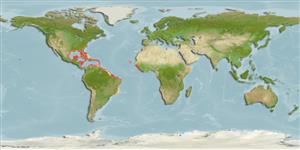
Benthic; distribuzione batimetrica 0 - 90 m (Fonte Biblio. 441). Tropical, preferred 27°C (Fonte Biblio. 107945); 35°N - 24°S, 97°W - 11°E (Fonte Biblio. 4)
Atlantic Ocean.
Lunghezza alla prima maturità / Dimensione / Peso / Età
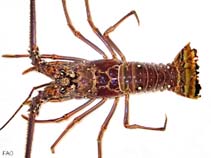
Maturità: Lm 8.3, range 7 - 8.1 cm Max length : 45.0 cm TL maschio/sesso non determinato; (Fonte Biblio. 4); common length : 20.0 cm TL maschio/sesso non determinato; (Fonte Biblio. 4); Età massima riportata: 15 anni (Fonte Biblio. 129472)
Longevity from Ref. 472'>129472 (Supplementary material). Occurs at depths down to 90 m, perhaps even deeper; usually inhabits shallow waters and found among rocks, on reefs, eelgrass beds or in any habitat that provides protection. The species is gregarious and migratory. Females move to deeper water for spawning and there are mass migrations in the autumn when the animals, in single files up to 50 individuals, move in a certain direction in daytime, each animal having body contact with the next through the antennae; In the northern part of its range, larvae are found mainly from June to December (Ref. 4).
Ciclo vitale e comportamento di accoppiamento
Maturità | Riproduzione | Deposizione | Uova | Fecondità | Larve
Females move to deeper water for spawning and there are mass migrations in the autumn when the animals, in single files up to 50 individuals, move in a certain direction in daytime, each animal having body contact with the next through the antennae; In the northern part of its range, larvae are found mainly from June to December (Ref. 4).
Holthuis, L.B. 1991 FAO Species Catalogue. Vol. 13. Marine lobsters of the world. An annotated and illustrated catalogue of species of interest to fisheries known to date. FAO Fish. Synop. 125(13):292p. Rome: FAO. (Fonte Biblio. 4)
Stato della Lista Rossa IUCN
(Fonte Biblio. 130435: Version 2025-2 (Global))
Stato della CITES (Fonte Biblio. 108899)
Not Evaluated
CMS (Fonte Biblio. 116361)
Not Evaluated
Minaccia per l'uomo
Usi umani
Pesca: commerciale
FAO - pesca: profilo della specie, landings search; Publication: search | FIRMS (Stock assessments) | FishSource | Sea Around Us
Strumenti
Informazioni ulteriori
Dinamica della popolazione FisiologiaConsumo di ossigeno
Legato all'uomoFrancobolli, monete, materiale vario.
Fonti Internet
Stime basate su modelli
Resilienza
(Ref. 69278): |
Medio, tempo minimo di raddoppiamento della popolazione 1.4 - 4.4 anni (K=0.16-0.39; tm=4) |
Rate of population increase
|
Prior r = 0.82, 95% CL = 0.54 - 1.23, Based on 1 full stock assessment. |
Vulnerabilità della pesca
(Fonte Biblio. 71543) |
Moderate vulnerability (42 of 100). |
Vulnerabilità climatica
(Fonte Biblio. 125649) |
High to very high vulnerability (66 of 100) |
Categoria di prezzo
(Fonte Biblio. 80766): |
Very high. |
Nutrients
|
Calcium = 109 [35, 184] mg/100g; Iron = 1.59 [1.21, 1.97] mg/100g; Protein = 20.2 [19.2, 21.3] %; Omega3 = 0.285 [0.185, 0.386] g/100g; Selenium = 48.3 [-31.7, 128.3] μg/100g; VitaminA = 0 μg/100g; Zinc = 1.79 [1.17, 2.40] mg/100g (wet weight); based on nutrient studies. |