Mammalia |
Cetartiodactyla |
Balaenopteridae
Ambiente: milieu / zona climática / intervalo de profundidade / gama de distribuição
Ecologia
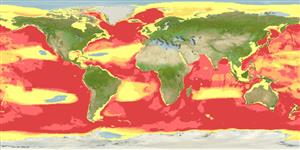
Pelágico(a,os,as); oceanódromo (Ref. 75906); intervalo de profundidade 80 - 500 m (Ref. 1005). Polar; 90°N - 90°S, 180°W - 180°E
North Atlantic and North Pacific: Balaenoptera musculus musculus.
North Atlantic [IUCN 2010 (Ref. 84930): VU, D1] and North Pacific [IUCN 2010 (Ref. 84930): LR/cd.
Comprimento na primeira maturidade / Tamanho / Peso / Idade
Maturidade: Lm ? range ? - ? cm Max length : 3,300 cm TL macho/indeterminado; (Ref. 99323); peso máx. Publicado: 160.0 t (Ref. 1394)
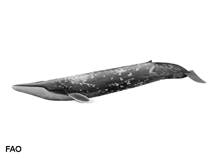
The largest whales of the world's oceans. They can be seen from the equator to the pack ice edges in both hemispheres, with most poleward intrusions in both hemispheres in summer. Some are resident, others are migratory. Feeds on krill (Ref. 1394). Feeds at depths less than 100 m (Ref. 1005). From the time faster catcher boats and explosive harpoons made them catchable, blue whales were hunted relentlessly from the late 19th through the mid 20th centuries. As the largest whales, they were the most sought after of the rorquals. Although most populations remain well below pre-exploitation levels, some stocks (such as those that feed off California) have shown encouraging signs of recovery since protection by the International Whaling Commission (IWC) in 1965. At least in the eastern North Atlantic and the eastern North Pacific, numbers appear to be on the rise (Ref. 1394). In general, they occur in coastal, shelf, and oceanic waters (Ref. 122680). They can be seen from the equator to the pack ice edges in both hemispheres, with most poleward intrusions in both hemispheres in summer. Some are resident, others are migratory (Ref. 1394). Known as 'gulpers,' feeding in separate events, often lunging at large schools of fish (Ref. 122680). Feeds on krill (Ref. 1394). Feeds at depths less than 100 m (Ref. 1005).
Ciclo de vida e comportamento de acasalamento
Maturidade | Reprodução | Desova | Ovos | Fecundidade | Larvas
Jefferson, T.A., S. Leatherwood and M.A. Webber 1993 FAO species Identification Guide: Marine Mammals of the World. Rome, FAO. 320 p. + 587 figures. (Ref. 1394)
Categoria na Lista Vermelha da IUCN
(Ref. 130435: Version 2025-2 (Global))
Categoria CITES (Ref. 108899)
Ameaça para o homem
Utilização humana
Pescarias: espécies comerciais
FAO - pescarias: perfil da espécie, landings search; Publication: search | FishSource | Sea Around Us
Ferramentas
Mais informação
FisiologiaConsumo de oxigénio
Relacionado com o ser humanoSelos, moedas, diversos.
Fontes da internet
Estimativas baseadas em modelos
Resiliência
(Ref. 69278): |
Baixo, tempo mínimo de duplicação da população 4,5 - 14 anos (K=0.08-0.09; tm=11) |
Vulnerabilidade da pesca
(Ref. 71543) |
Very high vulnerability (84 of 100). |
Categoria de preço
(Ref. 80766): |
Unknown. |