Malacostraca |
Decapoda |
Sergestidae
Environment: milieu / climate zone / depth range / distribution range
Ecology
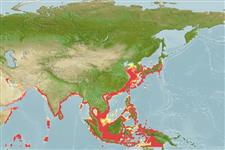
Pelagic; brackish; depth range 1 - 100 m (Ref. 101307). Tropical, preferred 23°C (Ref. 107945); 43°N - 12°S, 47°E - 143°E
Indo-West Pacific: from Kuwait Bay to North Korea, east to Japan, south to Papua, Indonesia.
Length at first maturity / Size / Weight / Age
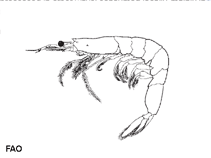
Maturity: Lm 1.8, range 2 - 1.8 cm Max length : 2.4 cm BL male/unsexed; (Ref. 409); 3 cm BL (female)
Phyto- and zooplanktivorous (Ref. 128452). Epipelagic, inhabits shallow coastal waters over muddy bottoms (Refs. 409, 128452). Found in a mangrove vegetate area (Ref. 121475).
Life cycle and mating behavior
Maturity | Reproduction | Spawning | Eggs | Fecundity | Larvae
Members of the order Decapoda are mostly gonochoric. Mating behavior: Precopulatory courtship ritual is common (through olfactory and tactile cues); usually indirect sperm transfer.
Chan, T.Y. 1998 Shrimps and prawns. 851-971. In Carpenter, K.E. and V.H.Niem (eds). FAO species identification guide for fishery purposes. The living marine resources of the Western Central Pacific. Vol. 2. Cephalopods, crustaceans, holothurians and sharks. Rome, FAO. 687-1396. (Ref. 409)
IUCN Red List Status
(Ref. 130435: Version 2025-2 (Global))
CITES status (Ref. 108899)
Not Evaluated
Not Evaluated
Threat to humans
Human uses
Fisheries: commercial
FAO - Aquaculture Systems: production searchFisheries: species profile, landings search; Publication: search | FishSource | Sea Around Us
Tools
More information
PhysiologyOxygen consumption
Human RelatedStamps, coins, misc.
Internet sources
Estimates based on models
Resilience
(Ref. 69278): |
High, minimum population doubling time less than 15 months (K=1.3-1.8) |
Rate of population increase
|
Prior r = 1.19, 95% CL = 0.79 - 1.79, Based on 3 data-limited stock assessments. |
Fishing Vulnerability
(Ref. 71543) |
Low vulnerability (10 of 100). |
Climate Vulnerability
(Ref. 125649) |
Moderate vulnerability (38 of 100) |
Price category
(Ref. 80766): |
Very high. |
Nutrients
|
Calcium = 109 [35, 184] mg/100g; Iron = 1.59 [1.21, 1.97] mg/100g; Protein = 20.2 [19.2, 21.3] %; Omega3 = 0.285 [0.185, 0.386] g/100g; Selenium = 48.3 [-31.7, 128.3] μg/100g; VitaminA = 0 μg/100g; Zinc = 1.79 [1.17, 2.40] mg/100g (wet weight); based on nutrient studies. |