Malacostraca |
Euphausiacea |
Euphausiidae
Environment: milieu / climate zone / depth range / distribution range
Ecology
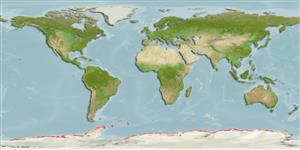
Pelagic; depth range 0 - 300 m (Ref. 138633), usually 15 - 130 m (Ref. 111951). Polar, preferred -1°C (Ref. 107945); 48°S - 78°S, 180°W - 180°E
Circumpolar in the Southern Ocean: from eastern Ross Sea to the Antarctic Peninsula and Weddell Sea, north to Kerguelen Islands, east to western Ross Sea.
Length at first maturity / Size / Weight / Age
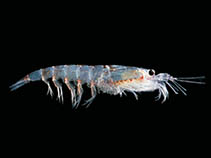
Maturity: Lm ? range ? - ? cm Max length : 3.0 cm TL male/unsexed; (Ref. 101405)
Minimum depth based from Ref. 111951. Found along most of the Antarctic coastline. Adult krill populations' center of distribution is near the continental shelf break, juveniles are found in inshore waters and the eggs and larvae are found in offshore waters (Ref. 96896).
Life cycle and mating behavior
Maturity | Reproduction | Spawning | Eggs | Fecundity | Larvae
Brinton, E. 1962 The distribution of Pacific euphausiids. 8(2), 51-270. In Fox, D.L., Arrhenius, G.O.S., Phleger, F.B. (eds.), Contribution from the Scripps Institution of Oceanography. Bulletin of the Scripps Institution of Oceanography of the Univeristy of California. University of California Press. California. (Ref. 2864)
IUCN Red List Status
(Ref. 130435: Version 2025-2 (Global))
CITES status (Ref. 108899)
Not Evaluated
Not Evaluated
Threat to humans
Human uses
Fisheries: commercial
FAO - Fisheries: species profile, landings search; Publication: search | FIRMS (Stock assessments) | FishSource | Sea Around Us
Tools
More information
Life cycleReproductionMaturityFecunditySpawningEggsEgg developmentLarvae PhysiologyOxygen consumption
Human RelatedStamps, coins, misc.
Internet sources
Estimates based on models
Resilience
(Ref. 69278): |
High, minimum population doubling time less than 15 months (K=0.43-0.5) |
Rate of population increase
|
Prior r = 0.51, 95% CL = 0.34 - 0.77, Based on 1 data-limited stock assessment. |
Fishing Vulnerability
(Ref. 71543) |
Low to moderate vulnerability (28 of 100). |
Climate Vulnerability
(Ref. 125649) |
High vulnerability (58 of 100) |
Price category
(Ref. 80766): |
High. |
Nutrients
|
Calcium = 109 [35, 184] mg/100g; Iron = 1.59 [1.21, 1.97] mg/100g; Protein = 20.2 [19.2, 21.3] %; Omega3 = 0.285 [0.185, 0.386] g/100g; Selenium = 48.3 [-31.7, 128.3] μg/100g; VitaminA = 0 μg/100g; Zinc = 1.79 [1.17, 2.40] mg/100g (wet weight); based on nutrient studies. |