Holothuroidea |
Synallactida |
Stichopodidae
Environment: milieu / climate zone / depth range / distribution range
Ecology
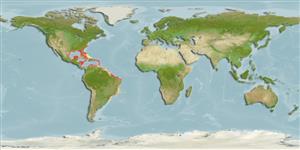
Benthic; depth range 0 - 65 m (Ref. 111335). Tropical; 36°N - 25°S, 98°W - 10°E (Ref. 92930)
Atlantic: from South Carolina, USA to the Carribean, south to Brazil, east to Ascension Island and Gulf of Guinea, West Africa. Tropical to subtropical.
Length at first maturity / Size / Weight / Age
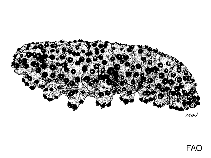
Maturity: Lm ? range ? - ? cm Max length : 20.0 cm TL male/unsexed; (Ref. 86832)
Inhabits Thalassia sp. beds and sandy areas (Ref. 415, 86832), particularly muddy sand (Ref. 86832).
Life cycle and mating behavior
Maturity | Reproduction | Spawning | Eggs | Fecundity | Larvae
Members of the class Holothuroidea are gonochoric and have only one gonad. Spawning and fertilization are both external and some exhibit brooding. Life cycle: Embryos develop into planktotrophic larvae (auricularia) then into doliolaria (barrel-shaped stage) which later metamorphose into juvenile sea cucumbers.
Collin, R., M.C. Díaz, J. Norenburg, R.M. Rocha, J.A. Sánchez, M. Schulze, A. Schwartz and A. Valdés 2005 Photographic identification guide to some common marine invertebrates of Bocas Del Toro, Panama. Caribbean Journal of Science. 41(3):638-707. (Ref. 415)
IUCN Red List Status
(Ref. 130435: Version 2025-2 (Global))
CITES status (Ref. 108899)
Not Evaluated
Not Evaluated
Threat to humans
Harmless
Human uses
FAO - Publication: search | FishSource |
Tools
More information
Trophic EcologyFood items (preys)
Diet composition
Food consumption
Predators
Life cycleReproductionMaturityFecunditySpawningEggsEgg developmentLarvae PhysiologyOxygen consumption
Human RelatedStamps, coins, misc.
Internet sources
Estimates based on models
Resilience
(Ref. 69278): |
High, minimum population doubling time less than 15 months (K=0.5) |
Fishing Vulnerability
(Ref. 71543) |
Low vulnerability (22 of 100). |
Price category
(Ref. 80766): |
Unknown. |