Holothuroidea |
Synallactida |
Stichopodidae
Umwelt: Milieu / Klimazone / Tiefenbereich / Verbreitungsgebiet
Ökologie
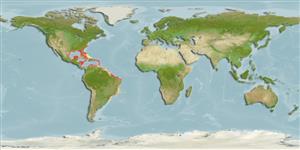
Benthic; tiefenbereich 0 - 65 m (Ref. 111335). Tropical; 36°N - 25°S, 98°W - 10°E (Ref. 92930)
Atlantic: from South Carolina, USA to the Carribean, south to Brazil, east to Ascension Island and Gulf of Guinea, West Africa. Tropical to subtropical.
Länge bei der ersten Reifung / Größe / Gewicht / Alter
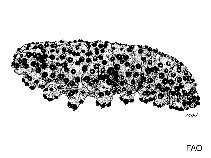
Geschlechtsreife: Lm ? range ? - ? cm Max length : 20.0 cm TL Männchen/unbestimmt; (Ref. 86832)
Inhabits Thalassia sp. beds and sandy areas (Ref. 415, 86832), particularly muddy sand (Ref. 86832).
Lebenszyklus und Paarungsverhalten
Geschlechtsreife | Fortpflanzung | Ablaichen | Eier | Fruchtbarkeit | Larven
Members of the class Holothuroidea are gonochoric and have only one gonad. Spawning and fertilization are both external and some exhibit brooding. Life cycle: Embryos develop into planktotrophic larvae (auricularia) then into doliolaria (barrel-shaped stage) which later metamorphose into juvenile sea cucumbers.
Collin, R., M.C. Díaz, J. Norenburg, R.M. Rocha, J.A. Sánchez, M. Schulze, A. Schwartz and A. Valdés 2005 Photographic identification guide to some common marine invertebrates of Bocas Del Toro, Panama. Caribbean Journal of Science. 41(3):638-707. (Ref. 415)
IUCN Rote Liste Status
(Ref. 130435: Version 2025-2 (Global))
CITES Status (Ref. 108899)
Not Evaluated
Not Evaluated
Bedrohung für Menschen
Harmless
Nutzung durch Menschen
FAO - Publication: search | FishSource |
Tools
Mehr Information
Trophische ÖkologieLebensmittel (Beutetiere)
Nahrungszusammensetzung
Nahrungsaufnahme
Räuber
LebenszyklusFortpflanzungGeschlechtsreifeFruchtbarkeitAblaichenEierEientwicklungLarven PhysiologieSauerstoffverbrauch
MenschenbezogenBriefmarken, Münzen, Verschiedenes.
Internet Quellen
Schätzungen auf der Grundlage von Modellen
Widerstandsfähigkeit
(Ref. 69278): |
hoch, Verdopplung der Population dauert weniger als 15 Monate. (K=0.5) |
Anfälligkeit der Fischerei
(Ref. 71543) |
Low vulnerability (22 of 100). |
Preiskategorie
(Ref. 80766): |
Unknown. |