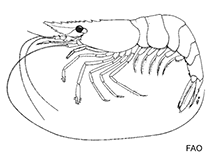
Malacostraca |
Decapoda |
Palaemonidae
Umwelt: Milieu / Klimazone / Tiefenbereich / Verbreitungsgebiet
Ökologie
Benthic; brackwasser; tiefenbereich 0 - 15 m (Ref. 97531). Tropical
Western Atlantic: USA and Canada. The Arctic. Tropical to polar climates of northern hemisphere.
Länge bei der ersten Reifung / Größe / Gewicht / Alter
Geschlechtsreife: Lm ? range ? - ? cm
Often found near underwater structures and dense stands of aquatic macrophytes in shallow areas of estuaries. During the spawning season, the female molts and becomes receptive to the male. Copulation occurs within 7 hours after molting. Ova are externally fertilized on the ventral surface of the female abdomen. Fecundity is between 247 to 486 eggs per female. Eggs hatch 12 to 60 days after fertilization. After spawning, the female molts again. Larvae are planktonic and feed on zooplankton, algae, and detritus. Movement and distributional patterns likely influenced by both photoperiod and tidal cycles. Mainly detritivorous; also feeds on epiphytic microalgae and prey on meiofauna and small infaunal polychaetes, oligochaetes, nematodes, epiphytic fauna, and mysids. Preyed upon by various estuarine fishes and other aquatic carnivores. Host to numerous species of parasites and ectocommensals, primarily coccidia, microsporidians, trematodes, isopods, and leeches (Ref. 96311). Also on seagrasses and submerged vegetation (Ref. 97531).
Lebenszyklus und Paarungsverhalten
Geschlechtsreife | Fortpflanzung | Ablaichen | Eier | Fruchtbarkeit | Larven
Members of the order Decapoda are mostly gonochoric. Mating behavior: Precopulatory courtship ritual is common (through olfactory and tactile cues); usually indirect sperm transfer.
Williams, A.B., L.G. Abele, D.L. Felder, H.H. Hobbs Jr., R.B. Manning, P.A. McLaughlin and I. Pérez Farfante 1988 Common and scientific names of aquatic invertebrates from the United States and Canada: decapod crustaceans. American Fisheries Society Special Publication 17. 77 pp. + 12 figs. (Ref. 2214)
IUCN Rote Liste Status
(Ref. 130435: Version 2025-2 (Global))
CITES Status (Ref. 108899)
Not Evaluated
Not Evaluated
Bedrohung für Menschen
Nutzung durch Menschen
FAO - Publication: search | FishSource |
Tools
Mehr Information
PopulationsdynamikWachstumMax. Alter/GrößenLänge-Gewicht-Rel.Länge-Länge-Verhältnis.LängenhäufigkeitenMassenkonvertierungDichte LebenszyklusFortpflanzungGeschlechtsreifeFruchtbarkeitAblaichenEierEientwicklungLarven PhysiologieSauerstoffverbrauch
MenschenbezogenBriefmarken, Münzen, Verschiedenes.
Internet Quellen
Schätzungen auf der Grundlage von Modellen