Malacostraca |
Decapoda |
Portunidae
Environnement : milieu / zone climatique / profondeur / gamme de distribution
Écologie
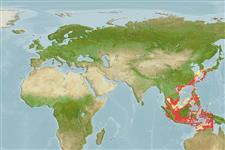
Récifal; saumâtre; profondeur 0 - 65 m (Réf. 111223). Tropical, preferred 26°C (Réf. 107945); 35°N - 15°S, 99°E - 137°E
Indo-West Pacific: from China, Japan and Korea to Philippines and westwards to the straits of Malaccca, also present in the Northern Territory, Australia. Tropical to subtropical.
Longueur à la première maturité / Taille / Poids / Âge
Maturité: Lm 6.5, range 6 - ? cm Max length : 20.0 cm CW mâle / non sexé; (Réf. 343)
Description synthétique
Morphologie
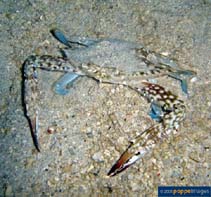
Carapace rough to granulose, regions discernible; front with 4 acutely triangular teeth; 9 teeth on each anterolateral margin, the last tooth 2 to 4 times larger than preceding teeth. Chelae elongate in males; larger chela with conical tooth at base of fingers; pollex ridged. Color: males with blue markings, females dull green.
Matures at about 1 year. Collected mainly by artisanal traps, trawls, beach seines, cylindrical wire traps, folding traps, pots, hop nets, drop nets, and sunken crab gill nets. In shallow waters, it is caught using beach seines, rakes, and dab nets. Sold in local markets (fresh or frozen) and for the crab-flesh canning industry. Most widely sold in markets of Southeast Asia, including the Philippines (Ref. 343). Maximum depth from Ref. 801. Immediate subtidal to a depth of 40 m (Ref. 801), on sandy to sandy-muddy substrates in areas near reefs, mangroves, and sea grass and algal beds (Ref. 343). Juveniles tend to occur in shallow intertidal areas (Ref. 343). Burrows in sand when disturbed; carnivorous and voracious predator (Ref. 801). Host to protozoans, helminths and crustaceans (Ref. 104981).
Cycle de vie et comportement reproducteur
Maturité | Reproduction | Frai | Œufs | Fécondité | Larves
Members of the order Decapoda are mostly gonochoric. Mating behavior: Precopulatory courtship ritual is common (through olfactory and tactile cues); usually indirect sperm transfer.
Ng, P.K.L. 1998 Crabs. p. 1045-1155. In K.E. Carpenter and V.H. Niem (eds) FAO species identification guide for fishery purposes. The living marine resources of the Western Central Pacific. Volume 2. Cephalopods, crustaceans, holothurians and sharks. Rome, FAO. 1998. pp. 687-1396. (Réf. 343)
Statut dans la liste rouge de l'IUCN
(Réf. 130435: Version 2025-2 (Global))
statut CITES (Réf. 108899)
Not Evaluated
Not Evaluated
Menace pour l'homme
Poisonous to eat (Réf. 130554)
Utilisations par l'homme
Pêcheries: hautement commercial
FAO - Aquaculture Systems: production searchpêcheries: Résumé espèce, landings search; Publication: search | FishSource | Sea Around Us
Outils
Plus d'informations
Dynamique des populations PhysiologieConsommation d'oxygène
Liées à l'hommeTimbres, pièces de monnaie, divers
Sources Internet
Estimations basées sur des modèles
Résilience
(Ref. 69278): |
Haut, temps minimum de doublement de population inférieur à 15 mois (K=0.1-3.11) |
Rate of population increase
|
Prior r = 1.19, 95% CL = 0.78 - 1.78, Based on 22 data-limited stock assessments. |
Vulnérabilité de la pêche
(Réf. 71543) |
Low vulnerability (10 of 100). |
Vulnérabilité climatique
(Réf. 125649) |
Low to moderate vulnerability (34 of 100) |
Catégorie de prix
(Réf. 80766): |
Very high. |
Nutrients
|
Calcium = 109 [35, 184] mg/100g; Iron = 1.59 [1.21, 1.97] mg/100g; Protein = 20.2 [19.2, 21.3] %; Omega3 = 0.285 [0.185, 0.386] g/100g; Selenium = 48.3 [-31.7, 128.3] μg/100g; VitaminA = 0 μg/100g; Zinc = 1.79 [1.17, 2.40] mg/100g (wet weight); based on nutrient studies. |