Scyphozoa |
Rhizostomeae |
Rhizostomatidae
Umwelt: Milieu / Klimazone / Tiefenbereich / Verbreitungsgebiet
Ökologie
Pelagic-neritic. Tropical; 45°N - 20°S, 44°E - 146°E (Ref. 121705)
Indo-West Pacific: from Gulf of Aden north to Japan and east to Pacific..
Länge bei der ersten Reifung / Größe / Gewicht / Alter
Geschlechtsreife: Lm ? range ? - ? cm Max length : 70.0 cm WD Männchen/unbestimmt; (Ref. 121705)
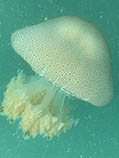
25 to 34 cm wide, exumbrella with numerous small, sharp-pointed, conical projections; in each octant about eight valer lappets, oblong, rounded; moutharms terminante in a lrge clubshaped appendage with a faceted, swollen end, other club-shaped appendages between the mouths on the three wings.
Depth estimate based on habitat data from its ecology. Found in coastal waters (Refs. 63414, 122791), in a bay (Ref. 122790) and estuary (Ref. 122791). Commensals: host to a few fishes (carangid, eel larvae, ponyfish), a shrimp, a crab, a copepod, and a flatworm (Ref. 116535). Also associated with the ophiuroid Ophiocnemis marmorata Ref. 122791).
Lebenszyklus und Paarungsverhalten
Geschlechtsreife | Fortpflanzung | Ablaichen | Eier | Fruchtbarkeit | Larven
Members of the class Scyphozoa are gonochoric. Life cycle: Egg is laid by the adult medusa which later develops into a free-living planula, then to a scyphistoma to a strobila, and lastly to a free-living young medusa.
Kramp, P.L. 1961 Synopsis of the medusae of the world. J Mar Biol Ass UK 40:1-469. (Ref. 2992)
IUCN Rote Liste Status
(Ref. 130435: Version 2025-2 (Global))
CITES Status (Ref. 108899)
Not Evaluated
Not Evaluated
Bedrohung für Menschen
Nutzung durch Menschen
Fischereien: kommerziell
FAO - Publication: search | FishSource |
Tools
Mehr Information
Trophische ÖkologieLebensmittel (Beutetiere)
Nahrungszusammensetzung
Nahrungsaufnahme
Räuber
PopulationsdynamikWachstumMax. Alter/GrößenLänge-Gewicht-Rel.Länge-Länge-Verhältnis.LängenhäufigkeitenMassenkonvertierungDichte LebenszyklusFortpflanzungGeschlechtsreifeFruchtbarkeitAblaichenEierEientwicklungLarven PhysiologieSauerstoffverbrauch
MenschenbezogenBriefmarken, Münzen, Verschiedenes.
Internet Quellen
Schätzungen auf der Grundlage von Modellen
Anfälligkeit der Fischerei
(Ref. 71543) |
Moderate to high vulnerability (48 of 100). |