Malacostraca |
Stomatopoda |
Eurysquillidae
Environnement : milieu / zone climatique / profondeur / gamme de distribution
Écologie
Benthic; profondeur 14 - 335 m (Réf. 80410). Tropical
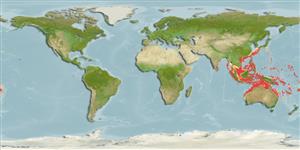
Indo-West Pacific.
Longueur à la première maturité / Taille / Poids / Âge
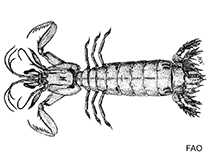
Maturité: Lm ? range ? - ? cm Max length : 5.6 cm TL mâle / non sexé; (Réf. 3130)
Found from rough to hard bottom substrate comprising from shell sand, corals, and algae, corals and shell sand, algae and grey gravel to corals hard bottom and coral blocks (Ref. 80410).
Cycle de vie et comportement reproducteur
Maturité | Reproduction | Frai | Œufs | Fécondité | Larves
Some members of the order Stomatopoda pair for life and some come together only to mate. Males produce sperm ducts rather than spermatophores; females can brood a maximum of 50,000 eggs. Life cycle: Eggs hatch to a planktonic zoea which lasts for 3 months.
Ahyong, S.T. 2001 Revision of the Australian stomatopod Crustacea. Records of the Australian Museum (Suppl. 26):326 p. (Réf. 3099)
Statut dans la liste rouge de l'IUCN
(Réf. 130435: Version 2025-2 (Global))
statut CITES (Réf. 108899)
Not Evaluated
Not Evaluated
Menace pour l'homme
Harmless
Utilisations par l'homme
FAO - Publication: search | FishSource |
Outils
Plus d'informations
Écologie trophiqueAliments (proies)
Composition du régime alimentaire
Consommation alimentaire
Prédateurs
Dynamique des populationsCroissanceÂges / tailles maximalesLongueur-poids rel.Rel. longueur-longueur.Fréquences de longueursConversion de masseAbondance Cycle de vieReproductionMaturitéFéconditéFraiŒufsDéveloppement de l'œufLarves PhysiologieConsommation d'oxygène
Liées à l'hommeTimbres, pièces de monnaie, divers
Sources Internet
Estimations basées sur des modèles
Vulnérabilité de la pêche
(Réf. 71543) |
Low vulnerability (10 of 100). |