Hexacorallia |
Actiniaria |
Diadumenidae
Environnement : milieu / zone climatique / profondeur / gamme de distribution
Écologie
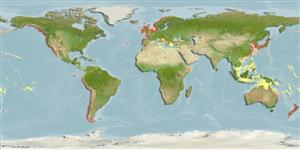
Sessile. Subtropical; 46°N - 22°N, 113°E - 146°E
Western Pacific.
Longueur à la première maturité / Taille / Poids / Âge
Maturité: Lm ? range ? - ? cm Max length : 3.0 cm H mâle / non sexé; (Réf. )
Description synthétique
Morphologie
Relatively small with tentacular crown up to 3.5 centimeters in diameter and 3 cm in height. Smooth green-gray or brown cylindrical column that may or may not have vertical orange or white stripes. 50 to 100 slender, tapering tentacles that are fully retractile, usually transparent, sometimes gray or light green flecked with white.
Known from infralittoral zones (Ref. 85338). Solitary (Ref. 2377). Found on rock surfaces, attached to one spot but can glide over the substrate. Will feed on any animal it can catch and swallow (Ref. 125338).
Cycle de vie et comportement reproducteur
Maturité | Reproduction | Frai | Œufs | Fécondité | Larves
Capable of both asexual reproduction, through longitudinal fission, and sexual reproduction through release of gametes by both sexes followed by external fertilization and embryonic development (Ref. 3248).
Cairns, S.D., D.R. Calder, A. Brinckmann-Voss, C.B. Castro, D.G. Fautin, P.R. Pugh, C.E. Mills, W.C. Jaap, M.N. Arai, S.H.D. Haddock and D.M. Opresko 2003 Common and Scientific Names of Aquatic Invertebrates from the United States and Canada: Cnidaria and Ctenophore, Second Edition. American Fisheries Society Special Publication, no,28. XI+115. With CD-ROM. (Réf. 1663)
Statut dans la liste rouge de l'IUCN
(Réf. 130435: Version 2025-2 (Global))
statut CITES (Réf. 108899)
Not Evaluated
Not Evaluated
Menace pour l'homme
Harmless
Utilisations par l'homme
FAO - Publication: search | FishSource |
Outils
Plus d'informations
Écologie trophiqueAliments (proies)
Composition du régime alimentaire
Consommation alimentaire
Prédateurs
Dynamique des populationsCroissance
Âges / tailles maximales
Longueur-poids rel.
Rel. longueur-longueur.
Fréquences de longueurs
Conversion de masse
Abondance
Cycle de vieReproductionMaturitéFéconditéFraiŒufsDéveloppement de l'œufLarves PhysiologieConsommation d'oxygène
Liées à l'hommeTimbres, pièces de monnaie, divers
Sources Internet
Estimations basées sur des modèles
Vulnérabilité de la pêche
(Réf. 71543) |
Low vulnerability (10 of 100). |
Catégorie de prix
(Réf. 80766): |
Unknown. |