Articulata |
Terebratulida |
Terebratulidae
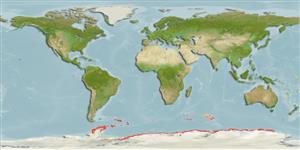
Environnement : milieu / zone climatique / profondeur / gamme de distribution
Écologie
Benthic; profondeur 232 - 385 m (Réf. 3597). Polar
Antarctic.
Longueur à la première maturité / Taille / Poids / Âge
Maturité: Lm ? range ? - ? cm
Minimum depth from Ref. 116836.
Cycle de vie et comportement reproducteur
Maturité | Reproduction | Frai | Œufs | Fécondité | Larves
Members of the phylum Brachiopoda are gonochoric. Eggs are shed into the water and fertilized at the time of spawning. Life cycle: Eggs develop into free-swimming larvae which later metamorphose into adult.
Peck, L.S. and K. Robinson 1994 Pelagic larval development in the brooding Antarctic brachiopod Liothyrella uva. Mar. Biol. 120:279-286. (Réf. 2169)
Statut dans la liste rouge de l'IUCN
(Réf. 130435: Version 2025-2 (Global))
statut CITES (Réf. 108899)
Not Evaluated
Not Evaluated
Menace pour l'homme
Harmless
Utilisations par l'homme
FAO - Publication: search | FishSource |
Outils
Plus d'informations
Écologie trophiqueAliments (proies)
Composition du régime alimentaire
Consommation alimentaire
Prédateurs
Dynamique des populationsCroissanceÂges / tailles maximalesLongueur-poids rel.Rel. longueur-longueur.Fréquences de longueursConversion de masseAbondance Cycle de vieReproductionMaturitéFéconditéFraiŒufsDéveloppement de l'œufLarves PhysiologieConsommation d'oxygène
Liées à l'hommeTimbres, pièces de monnaie, divers
Sources Internet
Estimations basées sur des modèles
Vulnérabilité de la pêche
(Réf. 71543) |
(0 of 100). |
Catégorie de prix
(Réf. 80766): |
Unknown. |