Cubozoa |
Carybdeida |
Carybdeidae
Milieu: milieu / Klimaatzone / Diepte / verspreidingsgebied
Ecologie
Benthopelagisch; diepte 0 - 20 m (Ref. 116114). Subtropical
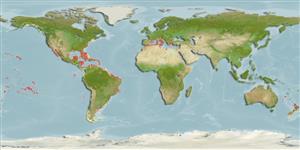
Eastern Central Pacific, Western Central Atlantic and the Mediterranean.
Lengte bij maturiteit / Grootte / Gewicht / Leeftijd
Maturiteit: Lm ? range ? - ? cm Max length : 4.0 cm H mannelijk / geslacht onbekend; (Ref. 2376)
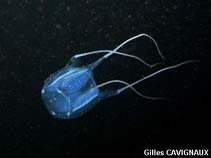
Stings are painful; second most important stinging jellyfish on the southcoast of Italy; in the coast of Denia (Western Mediterranean Sea), summer of 2008, it showed an unusual high density and stung as many as 185 people d-1 (Ref. 116819). Neritic (Ref. 116114). Inhabits near shore, mangrove channels, and kelp forests (Ref. 1028). Polyps were once located attached to bivalve shells in a mangrove habitat in Puerto Rico, suggesting estuarine polyps (Ref. 116835). Medusae are associated with sandy beach with Posidonia oceanica meadows (Ref. 116819). Pathogenic (Ref. 116114). Mainly feeds on copepods, mysids and gammarids (Ref. 116521). Temperature is the main factor which affects its spatio-temporal abundance along the SW Mediterranean; other variables were low salinity and high coastal productivity (chl a and phosphate) (Ref. 116819).
Levenscyclus en paargedrag
Maturiteit | Voortplanting | Paaien | Eieren | Fecunditeit | Larven
Cairns, S.D., D.R. Calder, A. Brinckmann-Voss, C.B. Castro, D.G. Fautin, P.R. Pugh, C.E. Mills, W.C. Jaap, M.N. Arai, S.H.D. Haddock and D.M. Opresko 2003 Common and Scientific Names of Aquatic Invertebrates from the United States and Canada: Cnidaria and Ctenophore, Second Edition. American Fisheries Society Special Publication, no,28. XI+115. With CD-ROM. (Ref. 1663)
Status op de Rode Lijst van het IUCN
(Ref. 130435: Version 2025-2 (Global))
CITES status (Ref. 108899)
Not Evaluated
Not Evaluated
Gevaar voor de mens
Harmless
Gebruik door de mens
FAO - Publication: search | FishSource |
Tools
Meer informatie
PopulatiedynamicaGroei
Max. leeftijden / maten
Lengte-gewicht rel.
Lengte-lengte rel.
Lengtefrequenties
Massaconversie
Abundantie
LevenscyclusVoortplantingMaturiteitFecunditeitPaaienEierenOntwikkeling van de eierenLarven FysiologieZuurstofverbruik
Menselijk gerelateerdPostzegels, munten, diversen.
Internetbronnen
Schattingen op basis van modellen
Kwetsbaarheid van de visserij
(Ref. 71543) |
Low vulnerability (10 of 100). |
Prijsklasse
(Ref. 80766): |
Unknown. |