Gastropoda |
Littorinimorpha |
Strombidae
Environnement : milieu / zone climatique / profondeur / gamme de distribution
Écologie
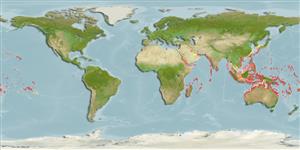
Récifal; profondeur 0 - 30 m (Réf. 349). Tropical; 37°N - 32°S, 29°E - 127°W
Indo-Pacific: from eastern Africa to Sudan, Egypt, Yemen and India, to southeast Asia and Australia, as far east to Pitcairn Islands and north to Hawaii and Japan. Tropical to subtropical.
Longueur à la première maturité / Taille / Poids / Âge
Maturité: Lm ? range ? - ? cm Max length : 43.0 cm SHL mâle / non sexé; (Réf. 349); common length : 28.0 cm SHL mâle / non sexé; (Réf. 349)
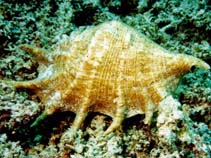
Actively collected by native populations for food, by hand at low tide on the reefs, or by diving. In spite of its weight and considerable size, the shell is favored, especially by tourists, due to the beauty of its heavily glazed aperture (Ref. 349). Found in shallow lagoons to the outer edge of reefs. Shell of old specimens often worn and encrusted with calcareous algae, vermetid snails, and tubes of polychaete worms (Ref. 349). Members of the genus Lambis are specialized herbivores, feeding on macroscopic or unicellular algae and algal detritus (Ref. 107011).
Cycle de vie et comportement reproducteur
Maturité | Reproduction | Frai | Œufs | Fécondité | Larves
Members of the order Neotaenioglossa are mostly gonochoric and broadcast spawners. Life cycle: Embryos develop into planktonic trocophore larvae and later into juvenile veligers before becoming fully grown adults.
Poutiers, J.M. 1998 Gastropods. p. 363-648. In Carpenter, K. E. and V. H. Niem. 1998. FAO species identification guide for fishery purposes. The living marine resources of the Western Central Pacific. Volume 1. Seaweeds, corals, bivalves, and gastropods. Rome, FAO. (Réf. 349)
Statut dans la liste rouge de l'IUCN
(Réf. 130435: Version 2025-2 (Global))
statut CITES (Réf. 108899)
Not Evaluated
Not Evaluated
Menace pour l'homme
Harmless
Utilisations par l'homme
Pêcheries: commercial
FAO - Publication: search | FishSource | Sea Around Us
Outils
Plus d'informations
Dynamique des populationsCroissance
Âges / tailles maximales
Longueur-poids rel.
Rel. longueur-longueur.
Fréquences de longueurs
Conversion de masse
Abondance
Cycle de vieReproductionMaturitéFéconditéFraiŒufsDéveloppement de l'œufLarves PhysiologieConsommation d'oxygène
Liées à l'hommeTimbres, pièces de monnaie, divers
Sources Internet
Estimations basées sur des modèles
Vulnérabilité de la pêche
(Réf. 71543) |
Low to moderate vulnerability (33 of 100). |
Catégorie de prix
(Réf. 80766): |
Unknown. |
Nutrients
|
Calcium = 126 [75, 177] mg/100g; Iron = 4.79 [1.67, 7.92] mg/100g; Protein = 15.9 [14.8, 16.9] %; Omega3 = 0.331 [0.263, 0.400] g/100g; Selenium = 57.8 [48.5, 67.2] μg/100g; VitaminA = 0 μg/100g; Zinc = 1.97 [0.92, 3.02] mg/100g (wet weight); based on nutrient studies. |