Gastropoda |
Not assigned |
Potamididae
Environnement : milieu / zone climatique / profondeur / gamme de distribution
Écologie
Benthic; saumâtre. Tropical
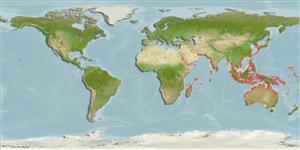
Indo-West Pacific: from India and Sri Lanka to Papua New Guinea; north to Japan and south to central Queensland.
Longueur à la première maturité / Taille / Poids / Âge
Maturité: Lm ? range ? - ? cm Max length : 4.5 cm SHL mâle / non sexé; (Réf. 349); common length : 3.5 cm SHL mâle / non sexé; (Réf. 349)
Description synthétique
Morphologie
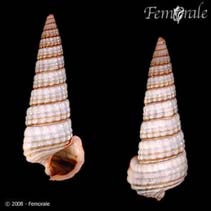
Shell small, with 8 to 9 whorls, and flat sided, with sutures being slightly impressed. Two channels on upper whorls and four on the body whorl are crossed by axial ribs, giving the shell a beaded appearance. A distinct rib is present on the body whorl of adult shells. Outer lip flared in adults, columella smooth, and the siphonal canal is short. Shell is yellowish, channels darker, and whitish near the outer edge of aperture. Operculum is light brown and horny.
Abundant on mud flats, in brackish or supersalted fishponds. Occur in the low to mid intertidal sections of protected bays. Also found on sand, seaward of mangroves (Ref. 128877). Locally, numbers of about 500 individuals per square meter can occur. Usually living in the upper bottom layer of mud which is almost liquid (Ref. 349). Detritus feeder (Ref. 751).
Cycle de vie et comportement reproducteur
Maturité | Reproduction | Frai | Œufs | Fécondité | Larves
Members of the order Neotaenioglossa are mostly gonochoric and broadcast spawners. Life cycle: Embryos develop into planktonic trocophore larvae and later into juvenile veligers before becoming fully grown adults.
Poutiers, J.M. 1998 Gastropods. p. 363-648. In Carpenter, K. E. and V. H. Niem. 1998. FAO species identification guide for fishery purposes. The living marine resources of the Western Central Pacific. Volume 1. Seaweeds, corals, bivalves, and gastropods. Rome, FAO. (Réf. 349)
Statut dans la liste rouge de l'IUCN
(Réf. 130435: Version 2025-2 (Global))
statut CITES (Réf. 108899)
Not Evaluated
Not Evaluated
Menace pour l'homme
Harmless
Utilisations par l'homme
FAO - Publication: search | FishSource |
Outils
Plus d'informations
Dynamique des populations Cycle de vieReproductionMaturitéFéconditéFraiŒufsDéveloppement de l'œufLarves PhysiologieConsommation d'oxygène
Liées à l'hommeTimbres, pièces de monnaie, divers
Sources Internet
Estimations basées sur des modèles
Vulnérabilité de la pêche
(Réf. 71543) |
Low vulnerability (10 of 100). |
Catégorie de prix
(Réf. 80766): |
Unknown. |