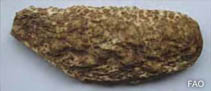
Holothuroidea |
Synallactida |
Stichopodidae
Milieu: milieu / Klimaatzone / Diepte / verspreidingsgebied
Ecologie
Benthic; diepte 20 - 53 m (Ref. 491). Temperate; 29°S - 53°S, 112°W - 179°W
Southwest Pacific and Western Indian Ocean: New Zealand and southern Australia.
Lengte bij maturiteit / Grootte / Gewicht / Leeftijd
Maturiteit: Lm ? range ? - ? cm Max length : 36.0 cm TL mannelijk / geslacht onbekend; (Ref. 492); max. gepubliceerd gewicht: 300.00 g (Ref. 124274)
Levenscyclus en paargedrag
Maturiteit | Voortplanting | Paaien | Eieren | Fecunditeit | Larven
Members of the class Holothuroidea are gonochoric and have only one gonad. Spawning and fertilization are both external and some exhibit brooding. Life cycle: Embryos develop into planktotrophic larvae (auricularia) then into doliolaria (barrel-shaped stage) which later metamorphose into juvenile sea cucumbers.
Mladenov, P.V. and A. Campbell 1998 Resource evaluation of the sea cucumber, Stichopus mollis, in the environmentally sensitive Fjordland region of New Zealand. p. 481-487. In Guille, D.B., J.P. Feral and M. Roux (eds.) Echinoderms Through Time. Proceedings of the Eighth International Echinoderm Conference, Dijon, France, 6-10 September 1993. A.A. Balkema Press, Rotterdam. (Ref. 491)
Status op de Rode Lijst van het IUCN
(Ref. 130435: Version 2025-2 (Global))
CITES status (Ref. 108899)
Not Evaluated
Not Evaluated
Gevaar voor de mens
Gebruik door de mens
Visserij: commercieel
FAO - Publication: search | FishSource |
Tools
Meer informatie
Trofische ecologieVoedsel (prooien)DieetsamenstellingVoedselconsumptiePredatoren PopulatiedynamicaGroeiMax. leeftijden / matenLengte-gewicht rel.Lengte-lengte rel.LengtefrequentiesMassaconversieAbundantie LevenscyclusVoortplantingMaturiteitFecunditeitPaaienEierenOntwikkeling van de eierenLarven FysiologieZuurstofverbruik
Menselijk gerelateerdPostzegels, munten, diversen.
Internetbronnen
Schattingen op basis van modellen
Weerstandsvermogen
(Ref. 69278): |
Hoog, minimale populatieverdubbelingstijd minder dan 15 maanden (K=1.37) |
Kwetsbaarheid van de visserij
(Ref. 71543) |
Low vulnerability (19 of 100). |
Prijsklasse
(Ref. 80766): |
Unknown. |