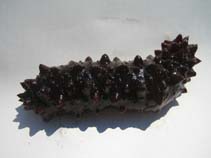
Holothuroidea |
Holothuriida |
Holothuriidae
Milieu: milieu / Klimaatzone / Diepte / verspreidingsgebied
Ecologie
Benthic; diepte 1 - 77 m (Ref. 85345). Subtropical
Verspreiding
Territories | FAO regio's | Ecosystemen | Voorkomen | Introducties
Atlantic and the Mediterranean Sea.
Lengte bij maturiteit / Grootte / Gewicht / Leeftijd
Maturiteit: Lm ? range ? - ? cm Max length : 15.0 cm TL mannelijk / geslacht onbekend; (Ref. 525)
Levenscyclus en paargedrag
Maturiteit | Voortplanting | Paaien | Eieren | Fecunditeit | Larven
Members of the class Holothuroidea are gonochoric and have only one gonad. Spawning and fertilization are both external and some exhibit brooding. Life cycle: Embryos develop into planktotrophic larvae (auricularia) then into doliolaria (barrel-shaped stage) which later metamorphose into juvenile sea cucumbers.
Pancucci-Papadopoulou, M.A. 1996 Fauna Graeciae VI. The Echinodermata of Greece. Fauna Graeciae, Hellenic Zoological Society. Athens, Greece. 149 p. (Ref. 466)
Status op de Rode Lijst van het IUCN
(Ref. 130435: Version 2025-2 (Global))
CITES status (Ref. 108899)
Not Evaluated
Not Evaluated
Gevaar voor de mens
Gebruik door de mens
FAO - Publication: search | FishSource |
Tools
Meer informatie
Trofische ecologieVoedsel (prooien)
Dieetsamenstelling
Voedselconsumptie
Predatoren
PopulatiedynamicaGroeiMax. leeftijden / matenLengte-gewicht rel.Lengte-lengte rel.LengtefrequentiesMassaconversieAbundantie LevenscyclusVoortplantingMaturiteitFecunditeitPaaienEierenOntwikkeling van de eierenLarven FysiologieZuurstofverbruik
Menselijk gerelateerdPostzegels, munten, diversen.
Internetbronnen
Schattingen op basis van modellen
Weerstandsvermogen
(Ref. 69278): |
Gemiddeld, minimale populatieverdubbelingstijd 1,4-4,4 jaar (K=0.21) |
Kwetsbaarheid van de visserij
(Ref. 71543) |
Moderate vulnerability (36 of 100). |
Prijsklasse
(Ref. 80766): |
Unknown. |