Holothuroidea |
Holothuriida |
Holothuriidae
Milieu: milieu / Klimaatzone / Diepte / verspreidingsgebied
Ecologie
Rifbewoner; diepte 0 - 20 m (Ref. 800). Tropical
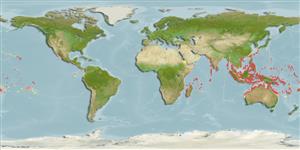
Indo-West Pacific, except the Hawaiian Islands.
Lengte bij maturiteit / Grootte / Gewicht / Leeftijd
Maturiteit: Lm ? range ? - ? cm Max length : 40.0 cm TL mannelijk / geslacht onbekend; (Ref. 118); max. gepubliceerd gewicht: 2.0 kg (Ref. 118)
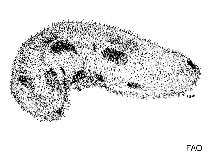
Cuverian tubules are extruded almost immediately after disturbance (Ref. 800). It occurs in coarse coral sand, from the intertidal to a depth of 20 m (Ref. 800). It is a burrowing form and comes out of the mud during cloudy days and at night (Ref. 118) being a nocturnal species (Ref. 85218). Particularly prefers reef flats and seagrass beds (Ref. 85218). Small individuals are usually buried in the sand while larger specimens are covered with a thin layer of sand (Ref. 800).
Levenscyclus en paargedrag
Maturiteit | Voortplanting | Paaien | Eieren | Fecunditeit | Larven
Spawning observed in March and April (Ref. 800).
Fischer, W., I. Sousa, A. de Freitas, J.M. Poutiers, W. Schneider, T.C. Borges, J.P. Féral and A. Massinga 1990 Fichas FAO de identificação de espécies para actividades de pesca. Guía de campo das espécies comerciais marinhas e de águas salobras de Moçambique. FAO. Rome. 424 p. (Ref. 418)
Status op de Rode Lijst van het IUCN
(Ref. 130435: Version 2025-2 (Global))
CITES status (Ref. 108899)
Not Evaluated
Not Evaluated
Gevaar voor de mens
Harmless
Gebruik door de mens
Visserij: commercieel
FAO - Publication: search | FishSource | Sea Around Us
Tools
Meer informatie
Trofische ecologieVoedsel (prooien)
Dieetsamenstelling
Voedselconsumptie
Predatoren
LevenscyclusVoortplantingMaturiteitFecunditeitPaaienEierenOntwikkeling van de eierenLarven FysiologieZuurstofverbruik
Menselijk gerelateerdPostzegels, munten, diversen.
Internetbronnen
Schattingen op basis van modellen
Kwetsbaarheid van de visserij
(Ref. 71543) |
Low to moderate vulnerability (30 of 100). |
Prijsklasse
(Ref. 80766): |
Unknown. |
Nutrients
|
Calcium = 126 [75, 177] mg/100g; Iron = 4.79 [1.67, 7.92] mg/100g; Protein = 16.6 [15.4, 17.8] %; Omega3 = 0.331 [0.263, 0.400] g/100g; Selenium = 57.8 [48.5, 67.2] μg/100g; VitaminA = 0 μg/100g; Zinc = 1.97 [0.92, 3.02] mg/100g (wet weight); based on nutrient studies. |