Gastropoda |
Ostreida |
Margaritidae
Environnement : milieu / zone climatique / profondeur / gamme de distribution
Écologie
Benthic; profondeur 0 - 150 m (Réf. 348), usually 5 - 25 m (Réf. 348). Tropical
Indo-Pacific and the Mediterranean Sea: from East Africa, to Melanesia and Hawaii; north to Japan and south to northern Victoria. Mediterranean Sea: Greece. Subtropical.
Longueur à la première maturité / Taille / Poids / Âge
Maturité: Lm 3.8 range ? - ? cm Max length : 10.1 cm SHH mâle / non sexé; (Réf. 127024); common length : 6.0 cm SHH mâle / non sexé; (Réf. 348)
Description synthétique
Morphologie
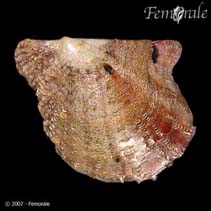
Shell rather thin and small to medium sized, relatively inflated, subquadrate in outline, with a short and ill defined posterior ear which is not drawn out into a wing-like process. Dorsal margin relatively long, anterior margin protruding only slightly or not at all beyond the tip of anterior ear. Outer surface of shell, when not worn, with densely set, appressed and flattened, imbricating concentric scales and moderately small, radially projecting spines mostly preserved towards the margins. Hinge line with 2 small teeth in each valve: 1 rounded anterior tubercle just in front of the umbo, and 1 posterior ridge, situated behind the ligamental area and almost parallel to dorsal margin. A small accessory ridge sometimes present above the posterior tooth of right valve. Colour: outside of shell variable, uniform or with darker markings or radial rays, mostly of reds and browns, but sometimes of green and bronze coloration. internal nacreous area highly iridescent. Non-nacreous margin glossy, light brown with dark brown or reddish blotches corresponding to the main external rays.
Collected in many areas of the Indo-West Pacific for its edible muscle, nacreous shell and ability to develop pearls (348). Byssally attached to rocks, dead corals and various submerged objects, often forming large natural banks. On soft bottoms, they aggregate to one another. Littoral, sublittoral and shelf zone, from low tide levels to a depth of about 150 m. Most common on sublittoral bottoms, from depths of 5 to 25 m (Ref. 348).
Cycle de vie et comportement reproducteur
Maturité | Reproduction | Frai | Œufs | Fécondité | Larves
Life cycle: Embryos develop into free-swimming trocophore larvae, succeeded by the bivalve veliger, resembling a miniature clam (Ref. 833).
Poutiers, J.M. 1998 Bivalves. Acephala, Lamellibranchia, Pelecypoda. p. 123-362. In Carpenter, K. E. and V. H. Niem. 1998. FAO species identification guide for fishery purposes. The living marine resources of the Western Central Pacific. Volume 1. Seaweeds, corals, bivalves, and gastropods. Rome, FAO. (Réf. 348)
Statut dans la liste rouge de l'IUCN
(Réf. 130435: Version 2025-2 (Global))
statut CITES (Réf. 108899)
Not Evaluated
Not Evaluated
Menace pour l'homme
Utilisations par l'homme
Pêcheries: commercial
FAO - Publication: search | FishSource |
Outils
Plus d'informations
Écologie trophiqueAliments (proies)
Composition du régime alimentaire
Consommation alimentaire
Prédateurs
Dynamique des populations PhysiologieConsommation d'oxygène
Liées à l'hommeTimbres, pièces de monnaie, divers
Sources Internet
Estimations basées sur des modèles
Résilience
(Ref. 69278): |
Haut, temps minimum de doublement de population inférieur à 15 mois (K=0.25-1.7) |
Vulnérabilité de la pêche
(Réf. 71543) |
Low vulnerability (24 of 100). |
Catégorie de prix
(Réf. 80766): |
Unknown. |