Bivalvia |
Ostreida |
Isognomonidae
Environnement : milieu / zone climatique / profondeur / gamme de distribution
Écologie
Benthic; profondeur 0 - 20 m (Réf. 348). Tropical
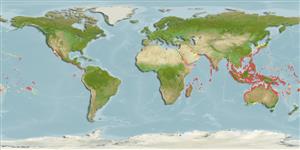
Indo-Pacific: from East Africa, to eastern Polynesia; north to southern Japan and south to Queensland.
Longueur à la première maturité / Taille / Poids / Âge
Maturité: Lm ? range ? - ? cm Max length : 15.0 cm ShL mâle / non sexé; (Réf. 348); common length : 10.0 cm SL mâle / non sexé; (Réf. 348)
Description synthétique
Morphologie
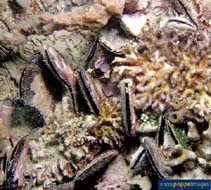
Shell relatively high and narrow in outline, with undulating commissure and strong posteroventral elongation. Shape often very irregular, due to the confined space in which the shell grows and to the effect of repair. Dorsal margin long and straight to slightly arched, more or less strongly expanded posteriorly in a wing-like ear that increases with growth and may attain a size double the length of shell. Anterior margin elongated, markedly sinuous dorsally and extending a little or not at all forward of umbones. Posterior margin concave near the posterior ear, then more or less parallel to anterior margin. Ventral margin roughly rounded. Umbones small, pointing at anterior end of dorsal margin. Outer surface with irregularly concentric lamellate processes, often encrusted with marine growths and corroded towards the umbones. Ligamental area with numerous transverse grooves (more than 20 in large specimens). Nacreous area of the inner side of shell more or less expanded ventrally, its margin often poorly defined. Colour: outside of shell bluish purple to almost black, often paler to whitish umbonally. Interior porcelaneous and similarly coloured on non-nacreous area; nacreous area much paler, with bluish purple hue.
Byssally attached to hard substrates, with the shell vertically disposed and the dorsal margin lying on the rock surface, or to boulders and corals. Often occurs in dense colonies (maximum recorded density of about 870 individuals/m2), sometimes forming mixed natural beds with Malleus regula. Littoral and sublittoral (Ref. 348).
Cycle de vie et comportement reproducteur
Maturité | Reproduction | Frai | Œufs | Fécondité | Larves
Members of the class Bivalvia are mostly gonochoric, some are protandric hermaphrodites. Life cycle: Embryos develop into free-swimming trocophore larvae, succeeded by the bivalve veliger, resembling a miniature clam.
Poutiers, J.M. 1998 Bivalves. Acephala, Lamellibranchia, Pelecypoda. p. 123-362. In Carpenter, K. E. and V. H. Niem. 1998. FAO species identification guide for fishery purposes. The living marine resources of the Western Central Pacific. Volume 1. Seaweeds, corals, bivalves, and gastropods. Rome, FAO. (Réf. 348)
Statut dans la liste rouge de l'IUCN
(Réf. 130435: Version 2025-2 (Global))
statut CITES (Réf. 108899)
Not Evaluated
Not Evaluated
Menace pour l'homme
Harmless
Utilisations par l'homme
FAO - Publication: search | FishSource |
Outils
Plus d'informations
Écologie trophiqueAliments (proies)
Composition du régime alimentaire
Consommation alimentaire
Prédateurs
Dynamique des populationsCroissanceÂges / tailles maximalesLongueur-poids rel.Rel. longueur-longueur.Fréquences de longueursConversion de masseAbondance Cycle de vieReproductionMaturitéFéconditéFraiŒufsDéveloppement de l'œufLarves PhysiologieConsommation d'oxygène
Liées à l'hommeTimbres, pièces de monnaie, divers
Sources Internet
Estimations basées sur des modèles
Vulnérabilité de la pêche
(Réf. 71543) |
Low vulnerability (10 of 100). |
Catégorie de prix
(Réf. 80766): |
Unknown. |