Bivalvia |
Mytilida |
Mytilidae
สิ่งแวดล้อม : สิ่งแวดล้อม / เขตภูมิอากาศ / ระดับความลึก / ระยะการกระจายสินค้า
นิเวศวิทยา
Benthic; ระดับความลึก 0 - 30 m (อ้างอิง 348). Tropical
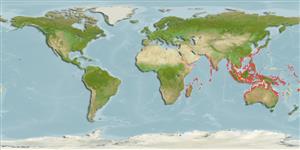
Indo-West Pacific: probably from Madagascar to the Philippines; north to China and south to northern Australia. Note that the exact distribution is not known because of persistent confusion with other species.
ความยาวเมื่อครบกำหนดครั้งแรก / ขนาด / น้ำหนัก / อายุ
วัยเจริญพันธุ์: Lm ? range ? - ? cm Max length : 5.0 cm SHL เพศผู้/กระเทย; (อ้างอิง 348); common length : 4.0 cm SHL เพศผู้/กระเทย; (อ้างอิง 348)
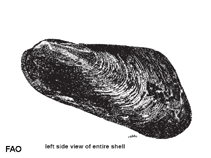
Often occurring gregariously, both on hard and soft substrates, and producing large quantities of byssal threads that generally enclose various small hard objects. Littoral and sublittoral to a depth of about 30 m (Ref. 348).
วงจรชีวิตและพฤติกรรมการผสมพันธุ์
วัยเจริญพันธุ์ | การสืบพันธุ์ | การวางไข่ | เซลสืบพันธ์ของเพศเมีย(ไข่) | ความดกของไข่ | ตัวอ่อน
Members of the class Bivalvia are mostly gonochoric, some are protandric hermaphrodites. Life cycle: Embryos develop into free-swimming trocophore larvae, succeeded by the bivalve veliger, resembling a miniature clam.
Poutiers, J.M. 1998 Bivalves. Acephala, Lamellibranchia, Pelecypoda. p. 123-362. In Carpenter, K. E. and V. H. Niem. 1998. FAO species identification guide for fishery purposes. The living marine resources of the Western Central Pacific. Volume 1. Seaweeds, corals, bivalves, and gastropods. Rome, FAO. (อ้างอิง 348)
สถานะบัญชีแดงของ IUCN
(อ้างอิง 130435: Version 2025-2 (Global))
สถานะไซเตส (อ้างอิง 108899)
Not Evaluated
CMS (อ้างอิง 116361)
Not Evaluated
ภัยคุกคามต่อมนุษย์
Harmless
การใช้ของมนุษย์
FAO - Publication: search | FishSource |
เครื่องมือ
ข้อมูลเพิ่มเติม
นิเวศวิทยาเขตร้อนรายการอาหาร (เหยื่อ)
องค์ประอบของอาหาร
การบริโภคอาหาร
ผู้ล่า
พลวัตของประชากรการเจริญเติบโต
อายุสูงสุด / ขนาด
ความยาว-น้ำหนักสัมพันธ์
ความยาว-ความยาวสัมพันธ์
ความยาว-ความถี่
การแปลงมวล
อุดมสมบรูณ์
วงจรชีวิตการสืบพันธุ์วัยเจริญพันธุ์ความดกของไข่การวางไข่เซลสืบพันธ์ของเพศเมีย(ไข่)การพัฒนาไข่ตัวอ่อน เกี่ยวข้องกับมนุษย์แสตมป์ เหรียญ อื่นๆ
แหล่งที่มาจากอินเตอร์เน็ต
การประมาณค่าตามแบบจำลอง
ความเสี่ยงต่อการตกปลา
(อ้างอิง 71543) |
Low vulnerability (10 of 100). |
หมวดหมู่ราคา
(อ้างอิง 80766): |
High. |