Bivalvia |
Mytilida |
Mytilidae
Milieu: milieu / Klimaatzone / Diepte / verspreidingsgebied
Ecologie
Benthic; diepte 0 - 25 m (Ref. 348). Tropical
Indo-West Pacific: from East Africa to the Philippines; north to Japan and south to Indonesia.
Lengte bij maturiteit / Grootte / Gewicht / Leeftijd
Maturiteit: Lm ? range ? - ? cm Max length : 8.0 cm TL mannelijk / geslacht onbekend; (Ref. 348); common length : 6.0 cm TL mannelijk / geslacht onbekend; (Ref. 348)
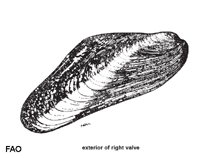
Shell rather inflated, roughly triangular and elongate-ovate in outline. Anterior margin short, slightly protruding anteriorly beyond the umbones. Posterodorsal margin straightish, forming a rather sharp angle with the produced, roundly wedge-shaped posterior margin. Ventral margin long and nearly straight in the posterior 2/3, recurved anteriorly. Outer surface smoothish, with only fine concentric growth marks, frequently eroded towards the umbones. Periostracum hairs not branched, developed on posterior half of the of valves. Hinge line smooth, without teeth or crenulations. Anterior adductor scar present. Internal margins smooth. Colour: outside of shell dull olive-brown, often with a median yellowish radial band. Interior pearly, pale greyish blue to purple.
Attached to pebbles or to mangrove prop roots, on muddy bottoms of sheltered bays, especially in areas under the influence of freshwater supply. Littoral and sublittoral to a depth of 25 m (Ref. 348).
Levenscyclus en paargedrag
Maturiteit | Voortplanting | Paaien | Eieren | Fecunditeit | Larven
Members of the class Bivalvia are mostly gonochoric, some are protandric hermaphrodites. Life cycle: Embryos develop into free-swimming trocophore larvae, succeeded by the bivalve veliger, resembling a miniature clam.
Poutiers, J.M. 1998 Bivalves. Acephala, Lamellibranchia, Pelecypoda. p. 123-362. In Carpenter, K. E. and V. H. Niem. 1998. FAO species identification guide for fishery purposes. The living marine resources of the Western Central Pacific. Volume 1. Seaweeds, corals, bivalves, and gastropods. Rome, FAO. (Ref. 348)
Status op de Rode Lijst van het IUCN
(Ref. 130435: Version 2025-2 (Global))
CITES status (Ref. 108899)
Not Evaluated
Not Evaluated
Gevaar voor de mens
Gebruik door de mens
Visserij: commercieel
FAO - Publication: search | FishSource |
Tools
Meer informatie
Trofische ecologieVoedsel (prooien)
Dieetsamenstelling
Voedselconsumptie
Predatoren
LevenscyclusVoortplantingMaturiteitFecunditeitPaaienEierenOntwikkeling van de eierenLarven FysiologieZuurstofverbruik
Menselijk gerelateerdPostzegels, munten, diversen.
Internetbronnen
Schattingen op basis van modellen
Kwetsbaarheid van de visserij
(Ref. 71543) |
Low vulnerability (10 of 100). |
Prijsklasse
(Ref. 80766): |
High. |