Bivalvia |
Cardiida |
Cardiidae
Ambiente: milieu / zona climatica / distribuzione batimetrica / gamma di distribuzione
Ecologia
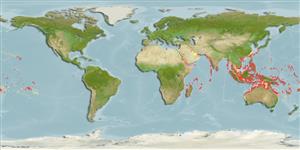
Benthic; distribuzione batimetrica 0 - 42 m (Fonte Biblio. 117184). Tropical; 31°N - 32°S, 30°E - 124°W
Indo-Pacific: from East Africa to the Red Sea, (but not the Persian Gulf) to as far east as Pitcairn Islands, north to southern Japan, and south to Queensland, Australia and New Caledonia. Introduced in Hawaii and Guam.
Lunghezza alla prima maturità / Dimensione / Peso / Età
Maturità: Lm ?, range 16 - 20 cm Max length : 45.0 cm SHL maschio/sesso non determinato; (Fonte Biblio. 95990); common length : 30.0 cm SHL maschio/sesso non determinato; (Fonte Biblio. 348)
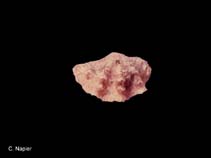
The species has an elongate shell with conspicuous fluted scales on its radial ridges. The valves are white and occasionally tinged with orange, and the mantle yellowish green.
Maximum depth from Ref. 87928. In eastern Polynesia, it is known to be restricted to deep water (Ref. 87928). Found in intertidal areas on corals (Ref. 75831). Abundant on outer reef slope (Ref. 2923). Also found in a lagoon (Ref. 87813), on sandy bottoms (Ref. 106695), rubble or in reef pockets (Ref. 2923). Unattached or weakly attached by byssus as an adult (Ref. 2923). Tridacnids derive their nutrition from uptake of dissolved matter through their epidermis and from their symbiotic zooanthella Symbiodinium microadriaticum (Ref. 107098).
Ciclo vitale e comportamento di accoppiamento
Maturità | Riproduzione | Deposizione | Uova | Fecondità | Larve
Life cycle: Embryos develop into free-swimming trocophore larvae, succeeded by the bivalve veliger, resembling a miniature clam (Ref. 833).
SAUP Database 2006 SAUP Database. www.seaaroundus.org. (Fonte Biblio. 356)
Stato della Lista Rossa IUCN
(Fonte Biblio. 130435: Version 2025-2 (Global))
Stato della CITES (Fonte Biblio. 108899)
CMS (Fonte Biblio. 116361)
Not Evaluated
Minaccia per l'uomo
Usi umani
Pesca: commerciale
FAO - Aquaculture Systems: production search; Publication: search | FishSource | Sea Around Us
Strumenti
Informazioni ulteriori
Dinamica della popolazione FisiologiaConsumo di ossigeno
Legato all'uomoFrancobolli, monete, materiale vario.
Fonti Internet
Stime basate su modelli
Resilienza
(Ref. 69278): |
Medio, tempo minimo di raddoppiamento della popolazione 1.4 - 4.4 anni (K=0.08-0.23; tm=4) |
Vulnerabilità della pesca
(Fonte Biblio. 71543) |
Moderate to high vulnerability (50 of 100). |
Categoria di prezzo
(Fonte Biblio. 80766): |
Unknown. |
Nutrients
|
Calcium = 149 [71, 228] mg/100g; Iron = 8.53 [1.95, 15.11] mg/100g; Protein = 9.88 [8.64, 11.12] %; Omega3 = 0.313 [0.202, 0.423] g/100g; Selenium = 61 [50, 72] μg/100g; VitaminA = 0 μg/100g; Zinc = 2.04 [0.56, 3.51] mg/100g (wet weight); based on nutrient studies. |