Bivalvia |
Cardiida |
Cardiidae
Umwelt: Milieu / Klimazone / Tiefenbereich / Verbreitungsgebiet
Ökologie
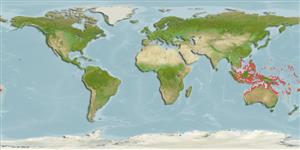
Benthic; tiefenbereich 0 - 20 m (Ref. 348), usually 0 - 15 m (Ref. 75831). Tropical; 23°C - 30°C (Ref. 102835); 19°N - 34°S, 100°E - 174°W (Ref. 106696)
Indo-West Pacific.
Länge bei der ersten Reifung / Größe / Gewicht / Alter
Geschlechtsreife: Lm ? range ? - ? cm Max length : 60.0 cm SHL Männchen/unbestimmt; (Ref. 348); common length : 50.0 cm SHL Männchen/unbestimmt; (Ref. 348)
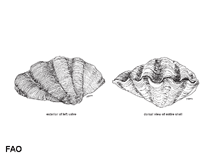
It is characterized by a low primary and radial sculpture, variable shape, massive umbonal area and smooth white shell.
Locally exploited for meat and shell. This species was previously quite abundant, but has been over collected in many areas. Aquaculture attempts being made (Ref. 348). Found in intertidal areas on corals (Ref. 75831), mainly on reef flats, barrier reefs, fore reefs and atoll lagoons (Ref. 117184). Common in shallow waters wherein juveniles are byssally attached to the tops and sides of coral outcrops. Adults are thought to detach their byssus and settle in clear ocean conditions at 20 m depth (Ref. 101207).
Lebenszyklus und Paarungsverhalten
Geschlechtsreife | Fortpflanzung | Ablaichen | Eier | Fruchtbarkeit | Larven
Life cycle: Embryos develop into free-swimming trocophore larvae, succeeded by the bivalve veliger, resembling a miniature clam (Ref. 833).
SAUP Database 2006 SAUP Database. www.seaaroundus.org. (Ref. 356)
IUCN Rote Liste Status
(Ref. 130435: Version 2025-2 (Global))
CITES Status (Ref. 108899)
Not Evaluated
Bedrohung für Menschen
Nutzung durch Menschen
Fischereien: kommerziell
FAO - Aquaculture Systems: production search; Publication: search | FishSource | Das Meer um uns herum
Tools
Mehr Information
Trophische ÖkologieLebensmittel (Beutetiere)
Nahrungszusammensetzung
Nahrungsaufnahme
Räuber
PhysiologieSauerstoffverbrauch
MenschenbezogenBriefmarken, Münzen, Verschiedenes.
Internet Quellen
Schätzungen auf der Grundlage von Modellen
Widerstandsfähigkeit
(Ref. 69278): |
niedrig, Verdopplung der Population dauert 4,5 - 14 Jahre. (K=0.11-0.11; tm=4) |
Anfälligkeit der Fischerei
(Ref. 71543) |
High vulnerability (57 of 100). |
Preiskategorie
(Ref. 80766): |
Unknown. |