Gastropoda |
Lepetellida |
Haliotidae
环境:氛围 / 气候带 / 深度上下限 / 分布范围
生态学
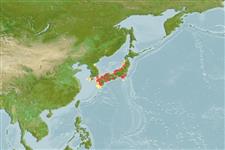
Benthic; 深度上下限 0 - 30 m (参考文献 113263). Subtropical; 41°N - 30°N, 124°E - 146°E
Northwest Pacific: Japan and Korea.
首次成熟时的长度 / 大小 / 重量 / 年龄
成熟度: Lm ? range ? - ? cm
Found along coastal waters (Ref. 106888).
生命周期和交配行为
成熟度 | 繁殖 | 产卵场 | 卵 | 孕卵数 | 仔鱼
Members of the order Patellogastropoda are mostly gonochoric and broadcast spawners. Life cycle: Embryos develop into planktonic trocophore larvae and later into juvenile veligers before becoming fully grown adults.
主要参考文献
参考文献 | 合作者 | 合作者
The Academy of Natural Sciences 2006 OBIS Indo-Pacific Molluscan Database. http://data.acnatsci.org/obis/find_mollusk.html [accessed 21/03/2007]. (参考文献 3204)
世界自然保护联盟红皮书
(参考文献 130435: Version 2025-2 (Global))
濒危 (EN) (A2d); Date assessed: 31 May 2022
Not Evaluated
Not Evaluated
对人类的威胁
人类利用
渔业: 商业性
FAO - Publication: search | FishSource | 周边海洋
工具
网络资源
基于模型的估算
渔业脆弱性
(参考文献 71543) |
(0 of 100). |
价格分类
(参考文献 80766): |
Very high. |
Nutrients
|
Calcium = 126 [75, 177] mg/100g; Iron = 4.79 [1.67, 7.92] mg/100g; Protein = 15.9 [14.8, 16.9] %; Omega3 = 0.331 [0.263, 0.400] g/100g; Selenium = 57.8 [48.5, 67.2] μg/100g; VitaminA = 0 μg/100g; Zinc = 1.97 [0.92, 3.02] mg/100g (wet weight); based on nutrient studies. |