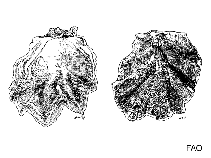
Bivalvia |
Ostreida |
Ostreidae
Milieu: milieu / Klimaatzone / Diepte / verspreidingsgebied
Ecologie
Benthic; brak water; diepte 0 - 300 m (Ref. 356). Tropical, preferred 28°C (Ref. 107945); 26°N - 5°N, 64°E - 94°E
Indo-Pacific.
Lengte bij maturiteit / Grootte / Gewicht / Leeftijd
Maturiteit: Lm ? range ? - ? cm Max length : 20.9 cm SHL mannelijk / geslacht onbekend; (Ref. 96220); max. gerapporteerde leeftijd: 4 Jaren (Ref. 8702)
Mainly inhabits brackish waters, wherein it occurs as thick beds in estuaries, backwaters, ports and harbors (Ref. 7693). Found in areas with somewhat reduced salinity within intertidal and shallow subtidal waters (Ref. 348). Though sporadic, it is also found on corals, rocks, hard objects or growing in bunches, on various soft bottoms to a depth of about 4 m (Refs. 101354, 53, 348 ). Feeds on diatoms, zooplankton and detritus (Ref. 107090). Also in Ref. 115735.
Levenscyclus en paargedrag
Maturiteit | Voortplanting | Paaien | Eieren | Fecunditeit | Larven
Members of the class Bivalvia are mostly gonochoric, some are protandric hermaphrodites. Life cycle: Embryos develop into free-swimming trocophore larvae, succeeded by the bivalve veliger, resembling a miniature clam.
SAUP Database 2006 SAUP Database. www.seaaroundus.org. (Ref. 356)
Status op de Rode Lijst van het IUCN
(Ref. 130435: Version 2025-2 (Global))
CITES status (Ref. 108899)
Not Evaluated
Not Evaluated
Gevaar voor de mens
Gebruik door de mens
Visserij: commercieel
FAO - Aquaculture Systems: production search; Publication: search | FishSource | Sea Around Us
Tools
Meer informatie
LevenscyclusVoortplantingMaturiteitFecunditeitPaaienEierenOntwikkeling van de eierenLarven FysiologieZuurstofverbruik
Menselijk gerelateerdPostzegels, munten, diversen.
Internetbronnen
Schattingen op basis van modellen
Weerstandsvermogen
(Ref. 69278): |
Hoog, minimale populatieverdubbelingstijd minder dan 15 maanden (K=0.35-1.8; tmax=4) |
Kwetsbaarheid van de visserij
(Ref. 71543) |
Low vulnerability (19 of 100). |
Kwetsbaarheid voor het klimaat
(Ref. 125649) |
High to very high vulnerability (68 of 100) |
Prijsklasse
(Ref. 80766): |
Medium. |