Bivalvia |
Arcida |
Arcidae
Umwelt: Milieu / Klimazone / Tiefenbereich / Verbreitungsgebiet
Ökologie
Benthic; tiefenbereich 0 - 20 m. Tropical, preferred 18°C (Ref. 107945)
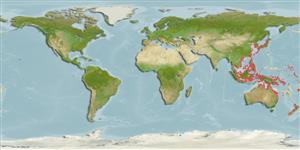
Western Pacific. Introduced in the Black Sea.
Länge bei der ersten Reifung / Größe / Gewicht / Alter
Geschlechtsreife: Lm ? range ? - ? cm Max length : 6.0 cm TL Männchen/unbestimmt; (Ref. 348); common length : 4.0 cm TL Männchen/unbestimmt; (Ref. 348)
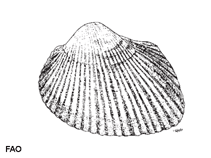
Shell thick and solid, inflated, inequilateral, somewhat transversally elongate in shape and with height greater than inflation, roughly quadrate to trapezoidal in outline; slightly inequivalve, left valve slightly overlapping right valve along posteroventral margin. Anterior margin rounded, ventral margin widely convex and meeting the oblique posterior margin at a blunt angle. Umbones moderately prominent, situated well anterior to midline valves. Posterodorsal slope flattened to slightly concave toward posterior end of dorsal margin, set off by a broad rounded ridge radiating from the umbones to posteroventral end of shell. Cardinal area rather narrow and elongated. About 28 radial ribs (26 to 30) at each valve, as wide as the interstices, mainly granulated on left valve. Periostracum well developed, concentrically striated, scaly to spiky in the interstices of ribs. Internal margins with strong crenulations corresponding with the external radial ribbing. No byssal gape. Colour: outside of shell white, frequently tinged deep bluish green posteriorly; periostracum dark greyish brown. Interior whitish.
Filter feeder (Ref. 128255). On sand and mud bottoms. Littoral and sublittoral to depth of about 20 m.
Lebenszyklus und Paarungsverhalten
Geschlechtsreife | Fortpflanzung | Ablaichen | Eier | Fruchtbarkeit | Larven
Members of the class Bivalvia are mostly gonochoric, some are protandric hermaphrodites. Life cycle: Embryos develop into free-swimming trocophore larvae, succeeded by the bivalve veliger, resembling a miniature clam.
Poutiers, J.M. 1998 Bivalves. Acephala, Lamellibranchia, Pelecypoda. p. 123-362. In Carpenter, K. E. and V. H. Niem. 1998. FAO species identification guide for fishery purposes. The living marine resources of the Western Central Pacific. Volume 1. Seaweeds, corals, bivalves, and gastropods. Rome, FAO. (Ref. 348)
IUCN Rote Liste Status
(Ref. 130435: Version 2025-2 (Global))
CITES Status (Ref. 108899)
Not Evaluated
Not Evaluated
Bedrohung für Menschen
Harmless
Nutzung durch Menschen
Fischereien: kommerziell
FAO - Fischereien: landings search; Publication: search | FishSource | Das Meer um uns herum
Tools
Mehr Information
Trophische ÖkologieLebensmittel (Beutetiere)
Nahrungszusammensetzung
Nahrungsaufnahme
Räuber
LebenszyklusFortpflanzungGeschlechtsreifeFruchtbarkeitAblaichenEierEientwicklungLarven PhysiologieSauerstoffverbrauch
MenschenbezogenBriefmarken, Münzen, Verschiedenes.
Internet Quellen
Schätzungen auf der Grundlage von Modellen
Widerstandsfähigkeit
(Ref. 69278): |
hoch, Verdopplung der Population dauert weniger als 15 Monate. (K=0.37) |
Anfälligkeit der Fischerei
(Ref. 71543) |
Low to moderate vulnerability (29 of 100). |
Klimaanfälligkeit
(Ref. 125649) |
Very high vulnerability (78 of 100) |
Preiskategorie
(Ref. 80766): |
Unknown. |
Nutrients
|
Calcium = 149 [71, 228] mg/100g; Iron = 8.53 [1.95, 15.11] mg/100g; Protein = 9.88 [8.64, 11.12] %; Omega3 = 0.313 [0.202, 0.423] g/100g; Selenium = 61 [50, 72] μg/100g; VitaminA = 0 μg/100g; Zinc = 2.04 [0.56, 3.51] mg/100g (wet weight); based on nutrient studies. |