Bivalvia |
Arcida |
Arcidae
Environnement : milieu / zone climatique / profondeur / gamme de distribution
Écologie
Benthic; profondeur 0 - 20 m (Réf. 348). Tropical
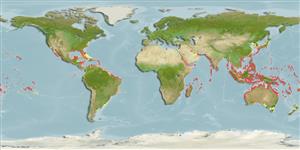
Indo-Pacific: East Africa to Red Sea and Polynesia.
Longueur à la première maturité / Taille / Poids / Âge
Maturité: Lm ? range ? - ? cm Max length : 9.0 cm TL mâle / non sexé; (Réf. 348); common length : 7.0 cm TL mâle / non sexé; (Réf. 348)
Description synthétique
Morphologie
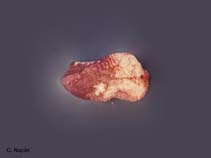
Shell equivalve, thick and inflated, very inequilateral, posteriorly expanded. Shape somewhat irregular, elongate rectangular in outline, with strongly protruding umbones anteriorly and a broad rounded keel from umbones to posteroventral margin. Posterior margin obliquely truncate, ventral margin slightly sinuous with a well-developed byssal gape. Cardinal area wide and riblets crossed by irregular growth marks, and a few larger radial ribs on posterodorsal slope. Periostracum coarsely pilose, mainly persisting towards shell margins. Hinge straight very long and narrow. Internal margins smooth. Colour: Outside of shell often encrusted with marine growths; posterior half dark brown, anterior half creamy white with zebra-like brown stripes. Inner side more or less strongly tinged with dark brown.
Found in reef areas of lagoons (Ref. 97298). Fixed on rocks, corals, or under stones. Littoral to sublittoral waters to a depth of 20 m (Ref. 348).
Cycle de vie et comportement reproducteur
Maturité | Reproduction | Frai | Œufs | Fécondité | Larves
Members of the class Bivalvia are mostly gonochoric, some are protandric hermaphrodites. Life cycle: Embryos develop into free-swimming trocophore larvae, succeeded by the bivalve veliger, resembling a miniature clam.
Poutiers, J.M. 1998 Bivalves. Acephala, Lamellibranchia, Pelecypoda. p. 123-362. In Carpenter, K. E. and V. H. Niem. 1998. FAO species identification guide for fishery purposes. The living marine resources of the Western Central Pacific. Volume 1. Seaweeds, corals, bivalves, and gastropods. Rome, FAO. (Réf. 348)
Statut dans la liste rouge de l'IUCN
(Réf. 130435: Version 2025-2 (Global))
statut CITES (Réf. 108899)
Not Evaluated
Not Evaluated
Menace pour l'homme
Harmless
Utilisations par l'homme
Pêcheries: commercial
FAO - Publication: search | FishSource |
Outils
Plus d'informations
Dynamique des populations Cycle de vieReproductionMaturitéFéconditéFraiŒufsDéveloppement de l'œufLarves PhysiologieConsommation d'oxygène
Liées à l'hommeTimbres, pièces de monnaie, divers
Sources Internet
Estimations basées sur des modèles
Résilience
(Ref. 69278): |
Faible, temps minimum de doublement de population : 4,5 à 14 années (K=0.06) |
Vulnérabilité de la pêche
(Réf. 71543) |
Moderate to high vulnerability (46 of 100). |
Catégorie de prix
(Réf. 80766): |
High. |