Holothuroidea |
Holothuriida |
Holothuriidae
Miljö: miljö / Klimatzon / djupintervall / distributionsområde
Ekologi
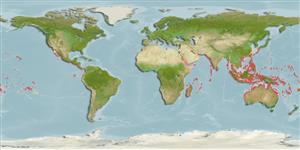
Revassocierade; djupintervall 6 - 13 m (Ref. 107862). Tropical; 33°N - 33°S, 28°E - 77°W (Ref. 107060)
Indo-Pacific.
Längd vid första mognad / Storlek / Vikt / Ålder
Könsmognad: Lm 22.0 range ? - ? cm Max length : 60.0 cm TL hane/ej könsbestämd; (Ref. 75656); common length : 35.0 cm TL hane/ej könsbestämd; (Ref. 122); publicerad maxvikt: 2.0 kg (Ref. 75656)
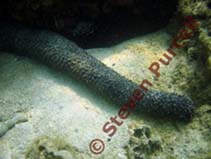
Mean live weight 300 to 800 g; body-wall thickness 0.3 cm. Body very elongate, narrower anteriorly than posteriorly. Tegument very smooth. Podia and papillae randomly distributed on bivium, the podia ending in a disc of around 480 micrometer diameter; podia on bivium numerous, short and stout, distributed on the radii and interradii, their calcareous disc and around 700 micrometer in diameter. Mouth ventral, surrounded by 20 black tentacles. Anus sub dorsal. Calcareous ring with large radial pieces and triangular interradials. Cuvierian tubules very thin and long. Entirely black. Spicules on dorsal and ventral tegument with tables and buttons; tables with circular large disc, having 8 holes or more, spire with 4 pillars, and ending in a crown with large central hole; buttons regular, with 6 or 8 holes, or irregular; plates large in ventral podia, with many holes; dorsal podia also with long rods; tentacles containing few rods.
Not traditionally harvested, due to the thin tegument and presence of Cuvierian tubules, but may be confused with other commercial black species of Holothuria. A shallow water species; mostly on outer and inner reef flats, back reefs, and shallow coastal lagoons. Abundant in seagrass beds, sandy-muddy grounds with rubble or coral patches where it hides the posterior part of its body (Ref. 122). Found under rocks to avoid dessication (Ref. 125338). Mean population density can exceed 0.5 per square meter. Inshore, shallow water populations are denser (Ref. 122). Feeds by extending its anterior end from a crevice (Ref. 85218). Deposit feeder (Ref. 103183). Sieves through the substrate it ingests, feeding on the organic matter (Ref. 125532). Found in waters less than 30m. Dwells intertidally, in pools and under rocks, and on soft substrates (Ref. 129602).
Livscykel och parningsbeteende
Könsmognad | Reproduktion | Lek | Ägg | Fekunditet | Larver
Inshore, shallow-water populations are composed of smaller individuals and reproduce mostly by transversal fission. Deeper or outer reef populations are composed of larger individuals reproducing sexually (Ref. 122). Members of the class Holothuroidea are gonochoric and have only one gonad. Spawning and fertilization are both external and some exhibit brooding. Life cycle: Embryos develop into planktotrophic larvae (auricularia) then into doliolaria (barrel-shaped stage) which later metamorphose into juvenile sea cucumbers (Ref. 833).
Conand, C. 1998 Holothurians (sea cucumbers, Class Holothuroidea). p. 1157-1190. In Carpenter, K.E. and V.H. Niem (eds.) FAO Species Identification Guide for Fishery Purposes. The Living Marine Resources of the Western Central Pacific. Vol. 2. Cephalopods, crustaceans, holothurians and sharks. FAO Rome. (Ref. 122)
Status på IUCN:s rödlista
(Ref. 130435: Version 2025-2 (Global))
CITES-status (Ref. 108899)
Not Evaluated
Not Evaluated
Hot mot människor
Harmless
Mänskliga användningsområden
Fiskeri: kommersiell
FAO - Publication: search | FishSource |
Verktyg
Ytterligare information
MänniskorelateradFrimärken, mynt, diverse.
Internet-källor
Uppskattningar baserade på modeller
Rate of population increase
|
Prior r = 1.20, 95% CL = 0.79 - 1.80, Based on 1 full stock assessment. |
Sårbarhet i fisket
(Ref. 71543) |
Low to moderate vulnerability (30 of 100). |
Priskategori
(Ref. 80766): |
Unknown. |