Holothuroidea |
Holothuriida |
Holothuriidae
Ambiente: milieu / zona climatica / distribuzione batimetrica / gamma di distribuzione
Ecologia
Associati a barriera corallina; distribuzione batimetrica 36 - 200 m (Fonte Biblio. 81020). Tropical
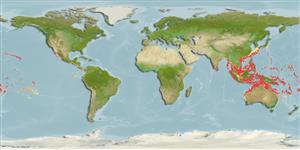
Widespread in the Indo-Pacific.
Lunghezza alla prima maturità / Dimensione / Peso / Età
Maturità: Lm ? range ? - ? cm Max length : 50.0 cm TL maschio/sesso non determinato; (Fonte Biblio. 85218); common length : 32.0 cm TL maschio/sesso non determinato; (Fonte Biblio. 122); peso massimo pubblicato: 1.6 kg (Fonte Biblio. 122)
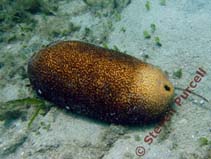
Mean live weight 1,200 to 1,600 g; body-wall thickness: 0.7 cm. Body cylindrical, arched dorsally (bivium) and flattened ventrally (trivium); calcareous disc of podia around 300 micrometer in diameter. Mouth ventral, surrounded by 20 small, short and yellowish tentacles. Anus nearly dorsal. Calcareous ring with large radial pieces and narrow interradials. Cuvierian tubules numerous and thick. Bivium yellow with brown band; trivium lighter; podia on bivium and trivium encircled by a characteristics brown spot. Spicules on ventral tegument with a variety of pseudo-rosettes and biscuit-like nodules; dorsal tegument with rosettes and a few rods; ventral podia with various rods; tentacles with rods, straight or slightly curved and very spiny.
May be harvested with other reef flat species, such as Bohadschia similis and Holothuria scabra, when they occur together, but the sticky Cuvierian tubules make the collection and processing disagreeable. Collected by hand at low tide, or by divers. Processed product is not distinguished from those of other Bohadschia species and is of little commercial value. Found in moderately shallow waters; mostly on coastal lagoons and inner reef flats; abundant in sandy-muddy sediments where it burrows most of the time (Ref. 122). Known to be nocturnally active (Ref. 85218). Population densities generally less than 0.02 per square meter (Ref. 122).
Ciclo vitale e comportamento di accoppiamento
Maturità | Riproduzione | Deposizione | Uova | Fecondità | Larve
Conand, C. 1998 Holothurians (sea cucumbers, Class Holothuroidea). p. 1157-1190. In Carpenter, K.E. and V.H. Niem (eds.) FAO Species Identification Guide for Fishery Purposes. The Living Marine Resources of the Western Central Pacific. Vol. 2. Cephalopods, crustaceans, holothurians and sharks. FAO Rome. (Fonte Biblio. 122)
Stato della Lista Rossa IUCN
(Fonte Biblio. 130435: Version 2025-2 (Global))
Stato della CITES (Fonte Biblio. 108899)
Not Evaluated
CMS (Fonte Biblio. 116361)
Not Evaluated
Minaccia per l'uomo
Harmless
Usi umani
Pesca: scarso interesse commerciale
FAO - Publication: search | FishSource | Sea Around Us
Strumenti
Informazioni ulteriori
Ecologia troficaArticoli alimentari (prede)
Alimentazione
Consumo di cibo
Predatori
Dinamica della popolazione Ciclo di vitaRiproduzioneMaturitàFeconditàDeposizioneUovaSviluppo delle uovaLarve FisiologiaConsumo di ossigeno
Legato all'uomoFrancobolli, monete, materiale vario.
Fonti Internet
Stime basate su modelli
Vulnerabilità della pesca
(Fonte Biblio. 71543) |
Moderate vulnerability (40 of 100). |
Categoria di prezzo
(Fonte Biblio. 80766): |
Unknown. |