Malacostraca |
Stomatopoda |
Odontodactylidae
Miljö: miljö / Klimatzon / djupintervall / distributionsområde
Ekologi
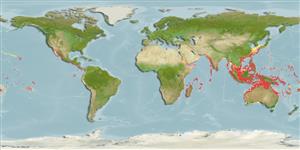
Revassocierade; djupintervall 0 - 100 m (Ref. 99185). Tropical
Indo-West Pacific.
Längd vid första mognad / Storlek / Vikt / Ålder
Könsmognad: Lm ? range ? - ? cm Max length : 17.0 cm TL hane/ej könsbestämd; (Ref. 92)
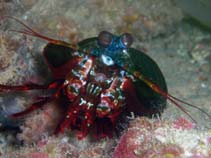
One of the most brightly colored stomatopods; with deep blue uropods; those and other appendages lined with bright red setae (Ref 92).
Intertidal to subtidal (Ref. 106854). Lives in existing burrows in shallow and rough bottom habitats, often on or near coral reefs (Ref. 92), and on reef flats at a depth of 36 m (Ref. 80410). Feeds on scyllarids; active during the day; uses its buttressed raptorial claws to smash hard-bodied prey. Largest 'smasher' (Ref. 92).
Livscykel och parningsbeteende
Könsmognad | Reproduktion | Lek | Ägg | Fekunditet | Larver
Some members of the order Stomatopoda pair for life and some come together only to mate. Males produce sperm ducts rather than spermatophores; females can brood a maximum of 50,000 eggs. Life cycle: Eggs hatch to a planktonic zoea which lasts for 3 months.
Manning, R.B. 1998 Stromatopods. p. 827-849. In Carpenter, K.E. and V.H. Niem (eds.) FAO Species Identifidication Guide for Fishery Purposes. The Living Marine Resources of the Western Central Pacific. Vol. 2. Cephalopods, crustaceans, holothurians and sharks. FAO Rome. (Ref. 92)
Status på IUCN:s rödlista
(Ref. 130435: Version 2025-2 (Global))
CITES-status (Ref. 108899)
Not Evaluated
Not Evaluated
Hot mot människor
Harmless
Mänskliga användningsområden
Akvarium: Kommersiell
FAO - Publication: search | FishSource |
Verktyg
Ytterligare information
PopulationsdynamikTillväxt
Max. åldrar / storlekar
Längd-vikt rel.
Längd-längd rel.
Längd-frekvenser
Massakonvertering
Abundans
LivscykelReproduktionKönsmognadFekunditetLekÄggUtveckling av äggLarver MänniskorelateradFrimärken, mynt, diverse.
Internet-källor
Uppskattningar baserade på modeller
Sårbarhet i fisket
(Ref. 71543) |
Low vulnerability (10 of 100). |
Priskategori
(Ref. 80766): |
Unknown. |