Holothuroidea |
Holothuriida |
Holothuriidae
Environnement : milieu / zone climatique / profondeur / gamme de distribution
Écologie
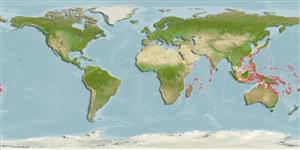
Récifal; profondeur 0 - 25 m (Réf. 108901), usually 0 - 10 m (Réf. 108901). Tropical
Indo-West Pacific: East Africa to Papua New Guinea and Australia.
Longueur à la première maturité / Taille / Poids / Âge
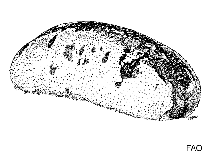
Maturité: Lm ? range ? - ? cm Max length : 48.0 cm TL mâle / non sexé; (Réf. 80470); common length : 35.0 cm TL mâle / non sexé; (Réf. 80470); poids max. publié: 2.8 kg (Réf. 122)
Maximum depth from Ref. 92930. Found on inner reef flats, coastal lagoons, seagrass beds, or sandflats at depths of 0 to 30 m (Ref. 92930). Occurs predominantly from 0 to 10 m (Ref. 98471). During specific time of the day, it buries in sand or muddy-sand (Ref. 92930).
Cycle de vie et comportement reproducteur
Maturité | Reproduction | Frai | Œufs | Fécondité | Larves
Members of the class Holothuroidea are gonochoric and have only one gonad. Spawning and fertilization are both external and some exhibit brooding. Life cycle: Embryos develop into planktotrophic larvae (auricularia) then into doliolaria (barrel-shaped stage) which later metamorphose into juvenile sea cucumbers.
Massin, C., S. Uthicke, S.W. Purcell, F.W.E. Rowe and Y. Samyn 2009 Taxonomy of the heavily exploited Indo-Pacific sandfish complex (Echinodermata: Holothuriidae). Zoological Journal of the Linnean Society 155:40-59. (Réf. 80470)
Statut dans la liste rouge de l'IUCN
(Réf. 130435: Version 2025-2 (Global))
statut CITES (Réf. 108899)
Not Evaluated
Not Evaluated
Menace pour l'homme
Harmless
Utilisations par l'homme
Pêcheries: hautement commercial
FAO - pêcheries: landings search; Publication: search | FishSource |
Outils
Plus d'informations
Écologie trophiqueAliments (proies)
Composition du régime alimentaire
Consommation alimentaire
Prédateurs
Dynamique des populationsCroissance
Âges / tailles maximales
Longueur-poids rel.
Rel. longueur-longueur.
Fréquences de longueurs
Conversion de masse
Abondance
Cycle de vieReproductionMaturitéFéconditéFraiŒufsDéveloppement de l'œufLarves PhysiologieConsommation d'oxygène
Liées à l'hommeTimbres, pièces de monnaie, divers
Sources Internet
Estimations basées sur des modèles
Vulnérabilité de la pêche
(Réf. 71543) |
Moderate vulnerability (38 of 100). |