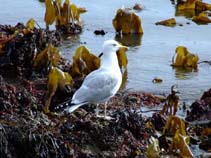
Aves |
Charadriiformes |
Laridae
Environnement : milieu / zone climatique / profondeur / gamme de distribution
Écologie
Others; eau douce; saumâtre. Tropical; 84°N - 36°S, 130°W - 128°E (Réf. 124582)
Indo-Pacific, Atlantic Ocean and the Arctic. Tropical to polar.
Longueur à la première maturité / Taille / Poids / Âge
Maturité: Lm ? range ? - ? cm Max length : 66.0 cm TL mâle / non sexé; (Réf. 8812); poids max. publié: 1.1 kg (Réf. 356)
Description synthétique
Morphologie
Culmen: 5.09 cm; tarsus: 5.715 cm; wing: 41.15 cm.
Total Length: 56 to 66 cm; Wingspan: 137 (Ref. 8812) to 147 cm (Ref. 84934). Total population is unknown but with over 1,000,000 pairs in the Palearctic and over 150,000 pairs in eastern North America. Population has expanded and is now considered a pest in some European countries (Ref. 84934). Colonies of these birds can extend to 2 km (Ref. 87784). It has a 70% dispersal rate (Ref. 87790). Dipping; surface seizing; shallow plunge diving; coastal; <100 km (Ref. 356). Largely dependent on freshwater and terrestrial environments. Feeds mostly on non-fish vertebrate prey. In the North Sea off the coasts of Scotland and northern England, is known to partially feed on the sandeel, Ammodytes marinus (Ref. 95711). Breeds colonially in a wide variety of habitats including roofs in North America, Europe and northeast Asia (Ref. 84934). One of its observed behavior is to balance between attack and fleeing, these birds redirects their aggression and attack to a substitute object like grass pulling (Ref. 87789). As for coloniality, they visit breeding colonies for a year to select a colony, a potential nesting site, and to obtain a mate to determine if the site is where young are successfully reared (Ref. 84934).
Cycle de vie et comportement reproducteur
Maturité | Reproduction | Frai | Œufs | Fécondité | Larves
Stiles, F.G. 1984 Status and conservation of seabirds in Costa Rican waters. In Croxall, J.P., Evans, P.G.H. and Schreiber, R.W. (eds.), Status and Conservation of the World's Seabirds. ICBP Technical Publication 2:223-229. (Réf. 5856)
Statut dans la liste rouge de l'IUCN
(Réf. 130435: Version 2025-2 (Global))
statut CITES (Réf. 108899)
Not Evaluated
Not Evaluated
Menace pour l'homme
Utilisations par l'homme
FAO - Publication: search | FishSource |
Outils
Plus d'informations
Dynamique des populationsCroissanceÂges / tailles maximalesLongueur-poids rel.Rel. longueur-longueur.Fréquences de longueursConversion de masseAbondance Cycle de vieReproductionMaturitéFéconditéFraiŒufsDéveloppement de l'œufLarves PhysiologieConsommation d'oxygène
Liées à l'hommeTimbres, pièces de monnaie, divers
Sources Internet
Estimations basées sur des modèles
Résilience
(Ref. 69278): |
Haut, temps minimum de doublement de population inférieur à 15 mois (K=23.52-45.31) |
Vulnérabilité de la pêche
(Réf. 71543) |
Moderate to high vulnerability (46 of 100). |
Catégorie de prix
(Réf. 80766): |
Unknown. |