Gastropoda |
Nudibranchia |
Polyceridae
Milieu: milieu / Klimaatzone / Diepte / verspreidingsgebied
Ecologie
Benthic; diepte 0 - 10 m (Ref. 7727). Tropical
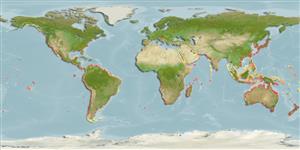
Indo-Pacific, Atlantic Ocean and the Mediterranean Sea.
Lengte bij maturiteit / Grootte / Gewicht / Leeftijd
Maturiteit: Lm ? range ? - ? cm Max length : 4.0 cm TL mannelijk / geslacht onbekend; (Ref. 844)
Assumed maximum length from Ref. 844. Feeds on arborescent bryozoans of the genus Bugula that grow as part of the fouling community in ships' hulls (Ref. 844 and 822); and on Bugula neritina, which is epizootic on eelgrass in shallow estuaries (Ref. 866).
Levenscyclus en paargedrag
Maturiteit | Voortplanting | Paaien | Eieren | Fecunditeit | Larven
Members of the order Nudibranchia are simultaneous hermaphrodites. Mating behavior: Both individuals darts their penis toward each other to induce one to act as a male and the other as the female. The victorious one to penetrate the body wall is the dominant male. Life cycle: Eggs are deposited on a substratum where they develop and hatch into (planktonic) vestigial veliger larval stage and further grow as adults.
Turgeon, D.D., J.F. Quinn Jr., A.E. Bogan, E.V. Coan, F.G. Hochberg, W.G. Lyons, P.M. Mikkelsen, R.J. Neves, C.F.E. Roper, G. Rosenberg, B. Roth, A. Scheltema, F.G. Thompson, M. Vecchione and J.D. Willams 1998 Common and scientific names of aquatic invertebrates from the United States and Canada: Mollusks, 2nd ed. American Fisheries Society (Special publication 26), Bethesda, Maryland. 526 p. (Ref. 1667)
Status op de Rode Lijst van het IUCN
(Ref. 130435: Version 2025-2 (Global))
CITES status (Ref. 108899)
Not Evaluated
Not Evaluated
Gevaar voor de mens
Gebruik door de mens
FAO - Publication: search | FishSource |
Tools
Meer informatie
PopulatiedynamicaGroei
Max. leeftijden / maten
Lengte-gewicht rel.
Lengte-lengte rel.
Lengtefrequenties
Massaconversie
Abundantie
LevenscyclusVoortplantingMaturiteitFecunditeitPaaienEierenOntwikkeling van de eierenLarven FysiologieZuurstofverbruik
Menselijk gerelateerdPostzegels, munten, diversen.
Internetbronnen
Schattingen op basis van modellen
Kwetsbaarheid van de visserij
(Ref. 71543) |
Low vulnerability (10 of 100). |
Prijsklasse
(Ref. 80766): |
Unknown. |