Mammalia |
Cetartiodactyla |
Delphinidae
Milieu: milieu / Klimaatzone / Diepte / verspreidingsgebied
Ecologie
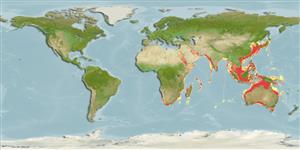
Pelagic-oceanic; oceanodroom (Ref. 75906); diepte 0 - 2000 m, usually 1 - 50 m. Tropical; 90°N - 90°S, 15°E - 180°E
Indian Ocean and Western Pacific Ocean.
Lengte bij maturiteit / Grootte / Gewicht / Leeftijd
Maturiteit: Lm ?, range 208 - 220 cm Max length : 270 cm BL mannelijk / geslacht onbekend; (Ref. 104989); max. gepubliceerd gewicht: 230.0 kg (Ref. 104988)
They prefer living on seagrass meadows and rocky substrata (Ref. 114971). Feeds on bony fishes and cephalopods (Ref. 84677). Attacked and preyed upon by tiger sharks Galeocerdo cuvier (Ref. 104930). This species was reported to display complex prey handling of the benthic-dwelling Maori octopus (Macroctopus maorum), processing its prey by shaking and tossing (Ref. 122728). The same octopus was reported to have asphyxiated an adult male of this species, with the octopus arms protruding from the mouth and the rest of the body blocking the pharynx, larynx and
esophagus (Ref. 122729). Occurs in pods of various numbers (Ref. 129713).
Levenscyclus en paargedrag
Maturiteit | Voortplanting | Paaien | Eieren | Fecunditeit | Larven
Rice, D.W. 1998 Marine Mammals of the World Systematics and Distribution. Special Publication number 4: The Society for Marine Mammalogy. 231p. (Ref. 1522)
Status op de Rode Lijst van het IUCN
(Ref. 130435: Version 2025-2 (Global))
CITES status (Ref. 108899)
Gevaar voor de mens
Gebruik door de mens
Visserij: commercieel; aas: usually
FAO - visserij: landings search; Publication: search | FishSource | Sea Around Us
Tools
Meer informatie
FysiologieZuurstofverbruik
Menselijk gerelateerdPostzegels, munten, diversen.
Internetbronnen
Schattingen op basis van modellen
Kwetsbaarheid van de visserij
(Ref. 71543) |
Very high vulnerability (90 of 100). |
Prijsklasse
(Ref. 80766): |
Unknown. |