Mammalia |
Cetartiodactyla |
Delphinidae
Milieu: milieu / Klimaatzone / Diepte / verspreidingsgebied
Ecologie
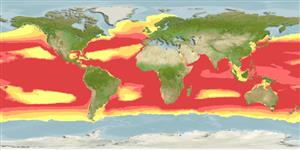
Pelagisch; standvastig (Ref. 75906); diepte 0 - 2418 m (Ref. 116169), usually 600 - 1000 m (Ref. 104603). Tropical; 15°C - 16°C (Ref. 97344); 90°N - 90°S, 180°W - 180°E
Atlantic Ocean and Indo-Pacific. Tropical and warm temperate.
Lengte bij maturiteit / Grootte / Gewicht / Leeftijd
Maturiteit: Lm 316.0, range 290 - 400 cm Max length : 610 cm TL mannelijk / geslacht onbekend; (Ref. 1394); 550 cm TL (female); max. gepubliceerd gewicht: 3.6 t (Ref. 1394)
Found in deep offshore areas (Ref. 936, 122680). Their main foraging grounds are those with high density of squid (Ref. 122680), its primary food. Sometimes feeds on fish (Refs. 936, 122680) and octopus (Ref. 122680). They are gregarious, rarely found solitary (Ref. 114960). Forms groups but hunts individually when feeding (Ref. 130961).
Levenscyclus en paargedrag
Maturiteit | Voortplanting | Paaien | Eieren | Fecunditeit | Larven
Males mature later than females because of their size and polygynous breeding behavior. Breeding longevity of Pacific species lasts for 17 to 31 years. Those less than 24 years old have a relatively high reproductive potential and longer resting period (Ref. 97344).
Tan, J.M.L. 1995 A Field Guide to the Whales and Dolphins in the Philippines. Makati City: Bookmark. 125 p. (Ref. 936)
Status op de Rode Lijst van het IUCN
(Ref. 130435: Version 2025-2 (Global))
CITES status (Ref. 108899)
Not Evaluated
Gevaar voor de mens
Gebruik door de mens
Visserij: commercieel
FAO - visserij: soortsprofiel, landings search; Publication: search | FishSource | Sea Around Us
Tools
Meer informatie
FysiologieZuurstofverbruik
Menselijk gerelateerdPostzegels, munten, diversen.
Internetbronnen
Schattingen op basis van modellen
Kwetsbaarheid van de visserij
(Ref. 71543) |
Very high vulnerability (90 of 100). |
Prijsklasse
(Ref. 80766): |
Unknown. |